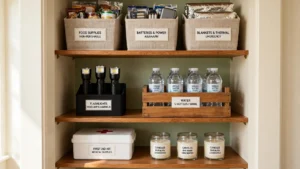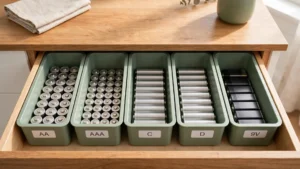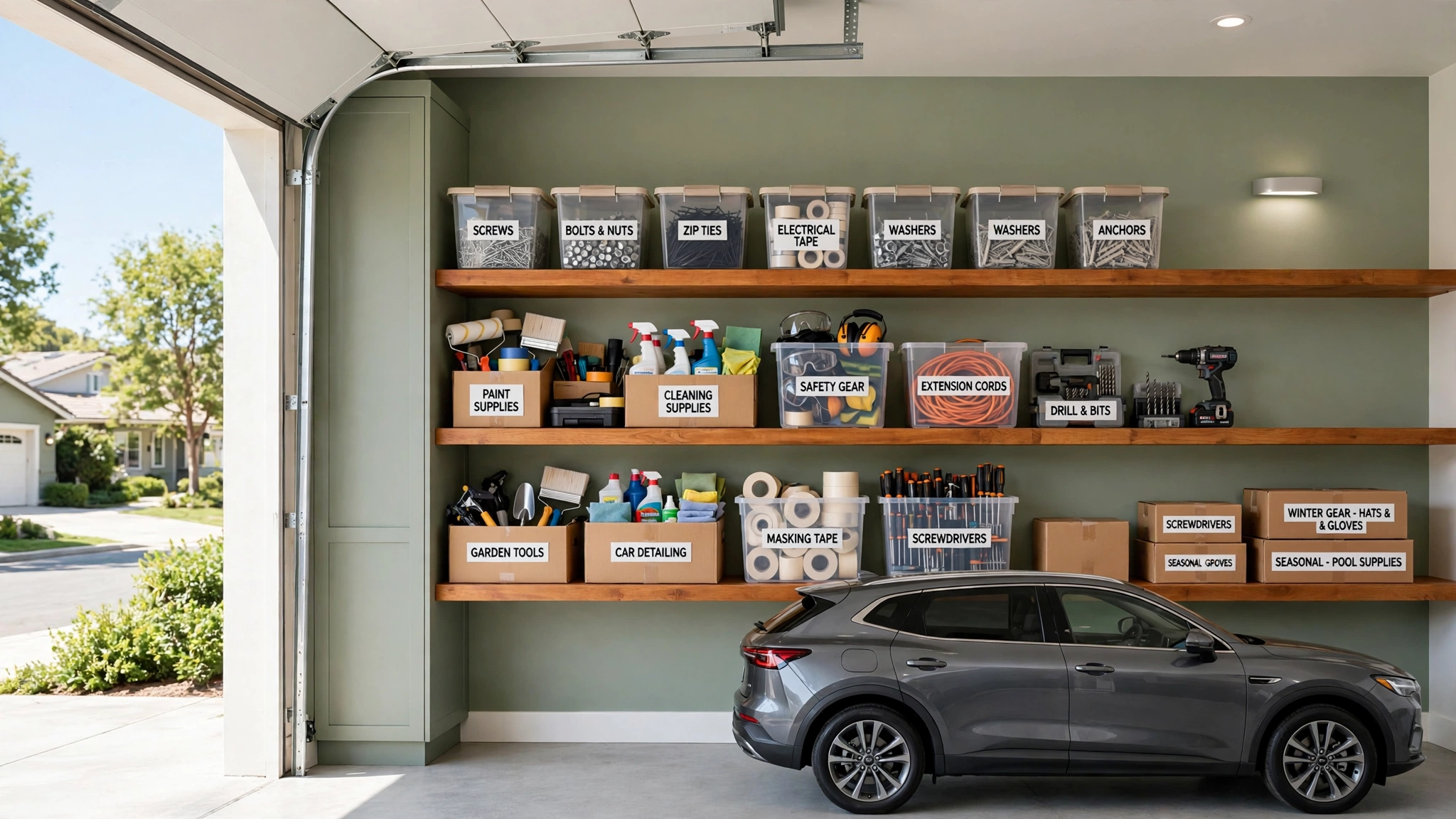
Picture this: you open the garage door and every tool, tote, and household supply sits in its own spot on a shelf. No more boxes stacked on the floor, no more hunting for the holiday lights in a dark corner. That calm feeling is exactly what good garage shelving gives you every single day.
You do not need a wider garage or a big budget to get there. All you need is the right shelf plan for your walls and your storage needs. These 29 garage shelf organization ideas will help you keep every item tidy, visible, and easy to reach without giving up your parking space.
1. Wire Shelves and Hanging Hooks
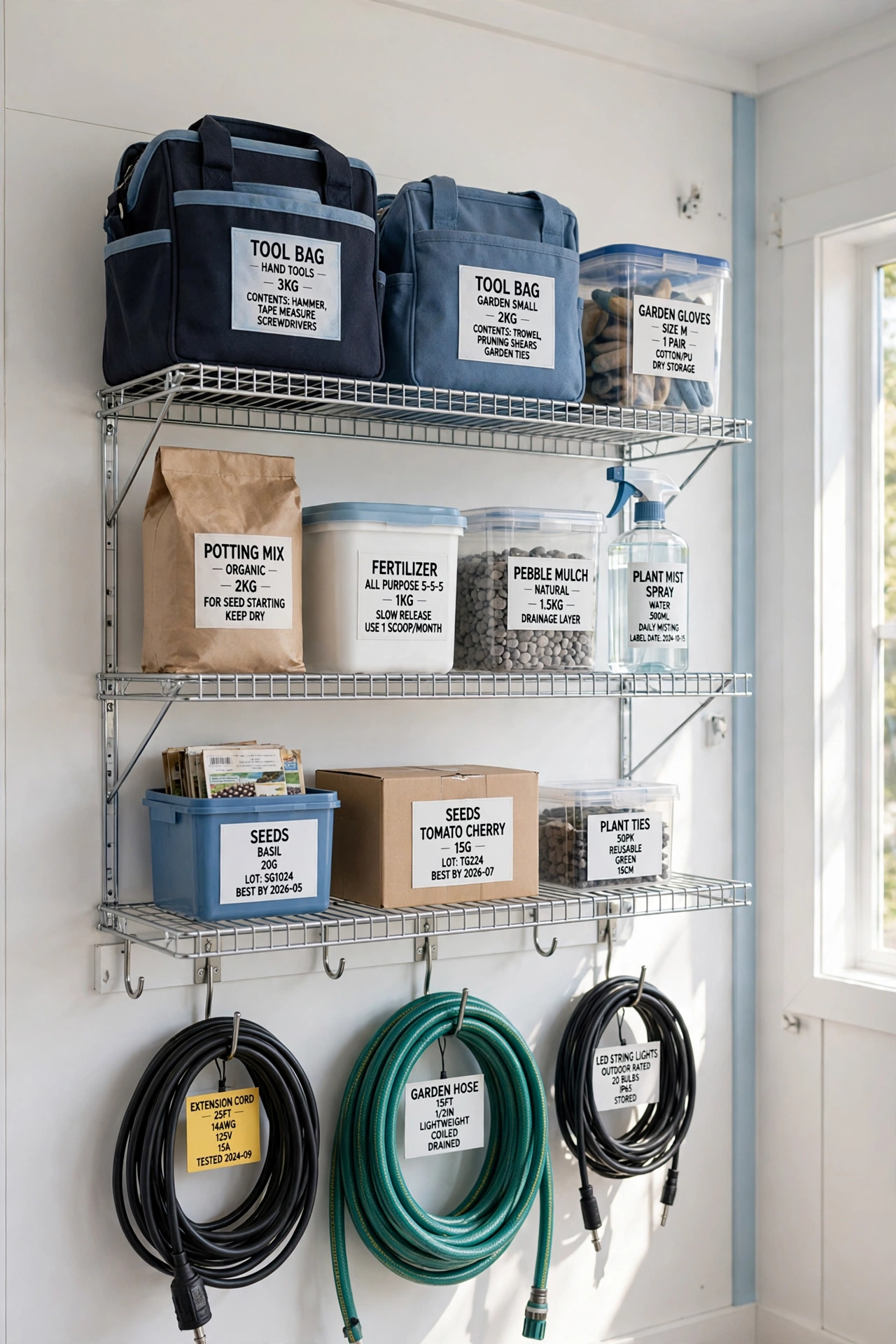
Open wire shelves are a strong start for any garage wall because they hold heavy items while letting air and light pass through. Tool bags sit on the top shelf while smaller gardening supplies get their own space below. The open design means you can see everything at a glance.
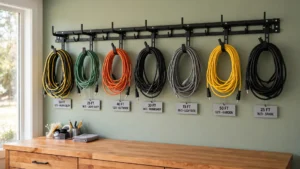
Add hooks beneath the lowest shelf to hold coiled cords, hoses, and extension leads. Leave a gap in the lower shelving if you need a spot for a tall bin. This simple setup turns one bare wall into a hard-working storage station.
2. Bins Above the Car
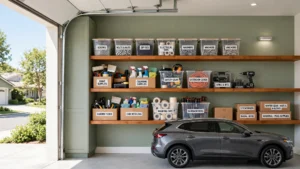
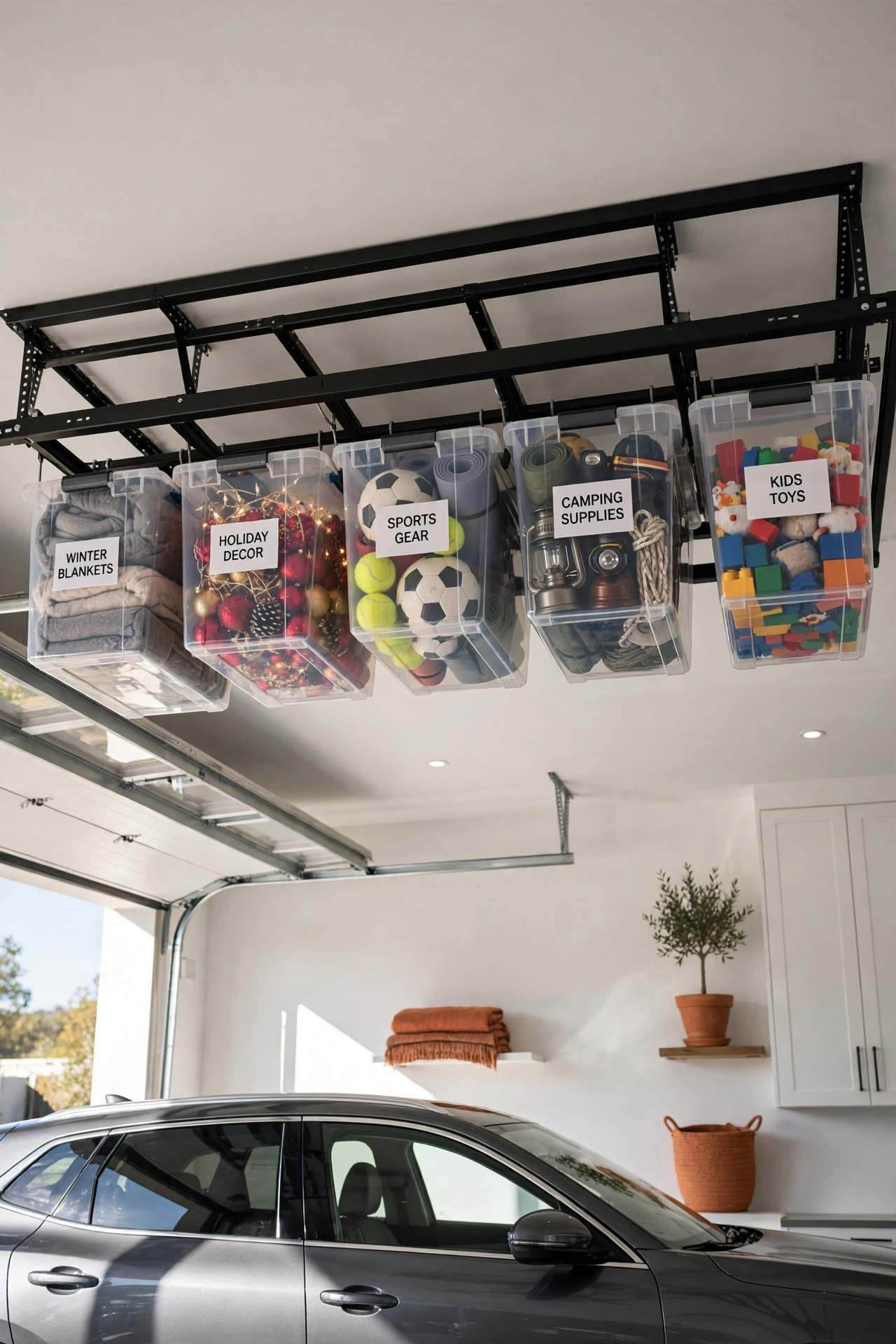
When wall space runs out, look up. A ceiling-mounted rack holds clear bins above the parked car, which uses space that would otherwise go completely unused. Group holiday decorations toward one end and camping gear toward the other so every bin has a clear purpose.
Check the rack load rating and the ceiling attachment requirements before you install it. Leave clearance for the vehicle and the full travel of the garage door. For more ideas on keeping car gear tidy, see these car trunk organization ideas.
3. Black Shelves with Yellow Accents
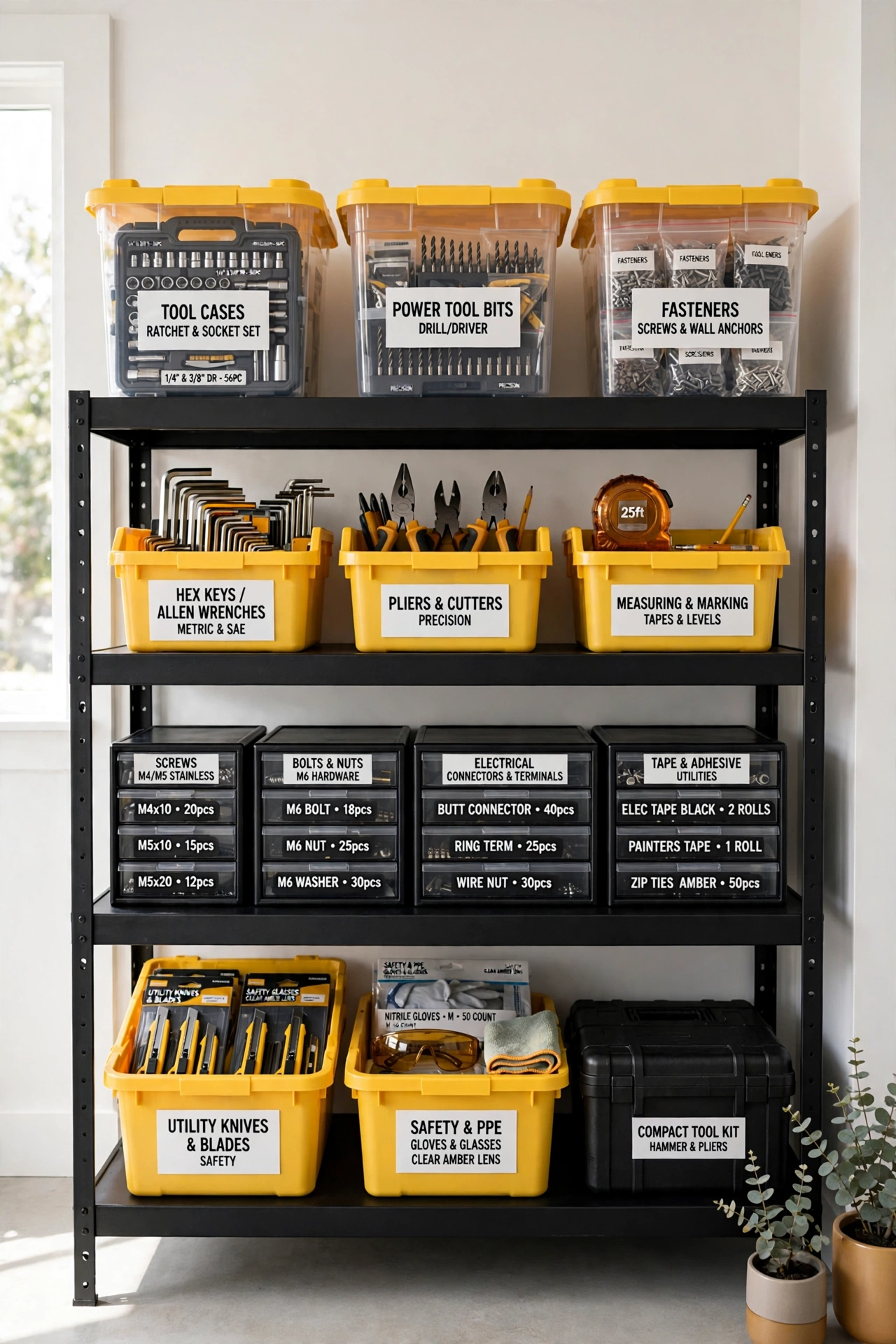
Black shelves with yellow bin lids give a garage a bold, workshop look while keeping supplies easy to find. The long rows give tool cases, small drawers, and larger boxes separate places without adding legs along the floor. The color contrast helps you spot the right bin from across the room.
Group your cases by size so you can see the smaller ones rather than hiding them behind big bins. Keep the yellow lids on the bins you reach for most often. This color system looks sharp and works just as well as it looks.
4. Plan a Tall Frame for Vertical Storage
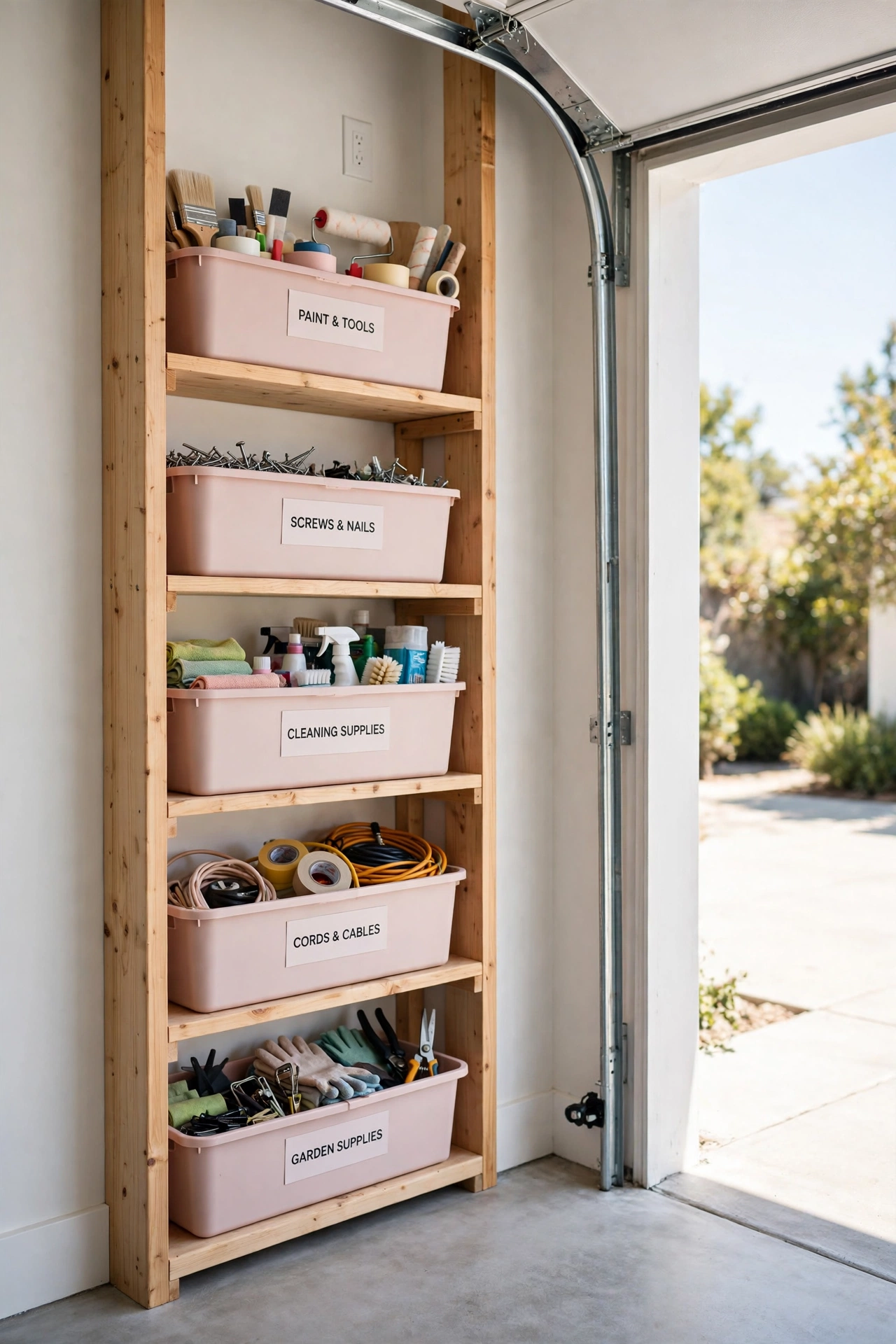
A tall frame that runs along a short wall beside an opening is a smart way to plan vertical storage in a narrow garage. The frame uses height that is usually wasted, and it leaves the floor free for walking and parking. Even a frame that is still a work in progress shows how much storage one wall can hold.
Measure the passage first before you build anything, and leave room for car doors to open. Plan your shelf heights around the tallest items you need to store. A tall frame rewards careful planning with storage that feels built for your garage.
5. Simple Black Slatwall Shelves
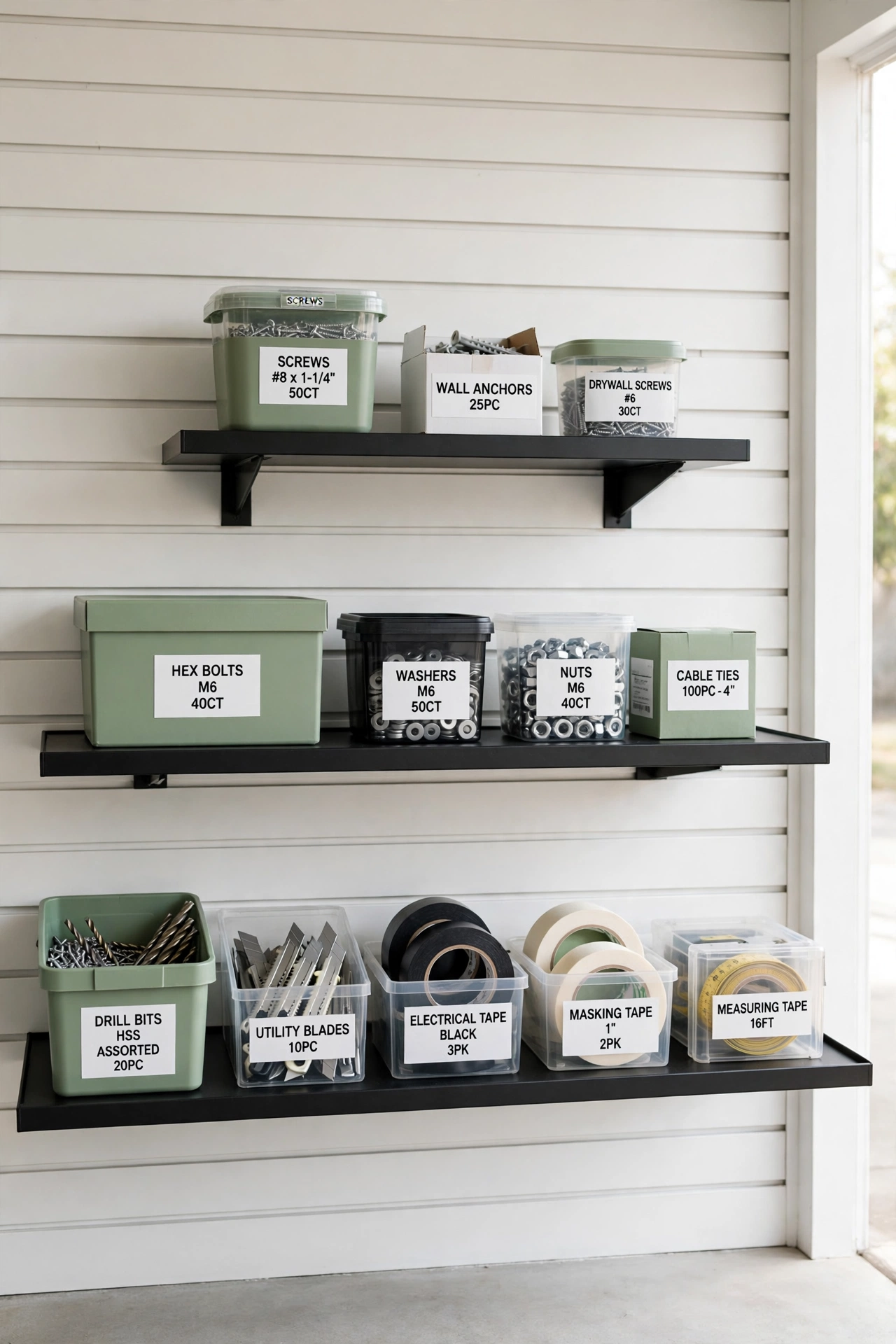
You do not need to cover the whole wall with storage to make a real difference. Three black shelves in different lengths against white slatwall keep things simple and tidy. The slatwall lets you move hooks and shelves around whenever your needs change.
Choose shelf sizes around what you actually need to store rather than filling every available slot. Short shelves hold small items, while a longer shelf takes care of bigger boxes. This simple setup suits small garages that need storage without feeling crowded.
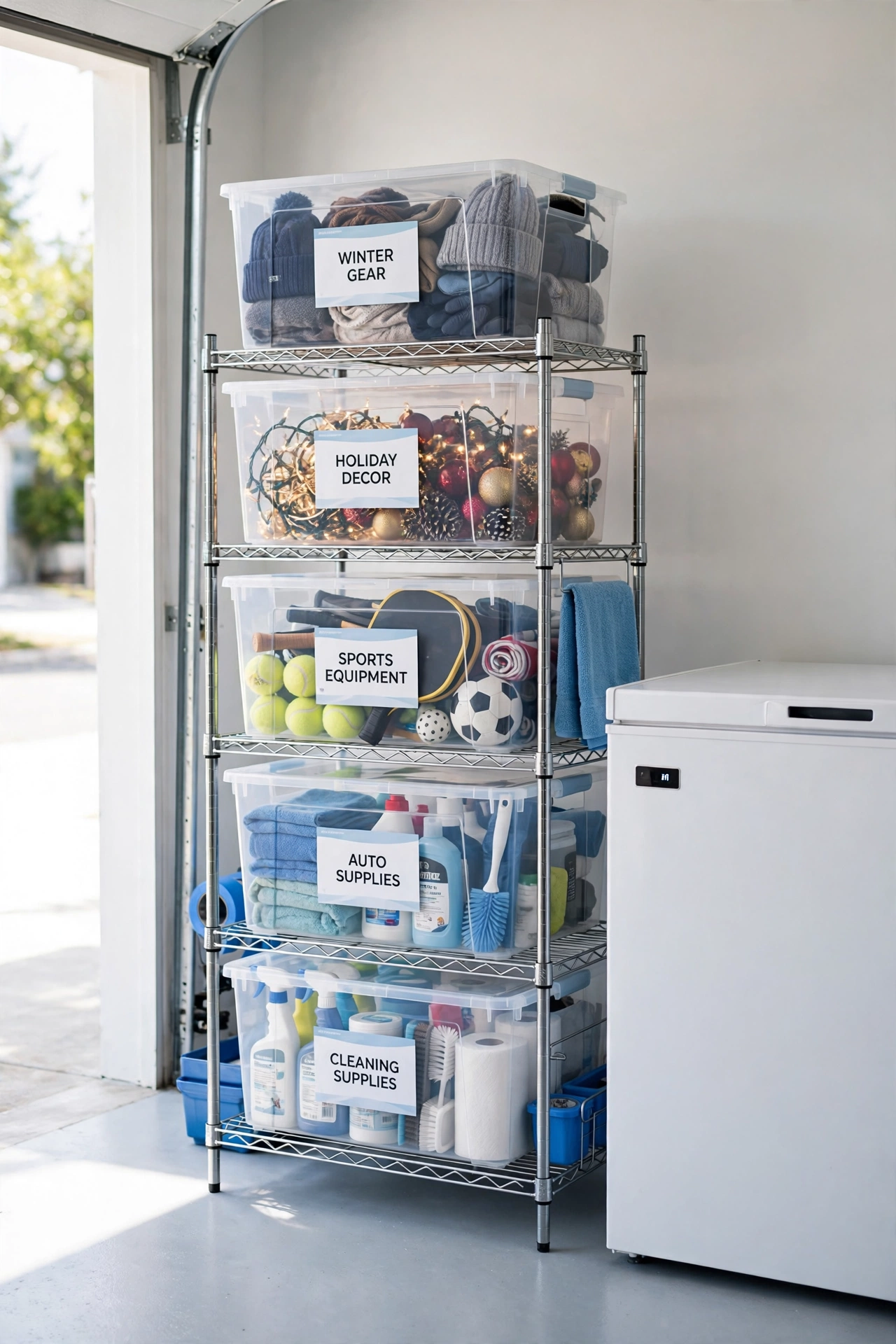
6. Clear Bins with Front Labels
Clear bins on a freestanding rack turn a jumble of supplies into a storage station you can read at a glance. Labels face forward so you know what is inside each bin without pulling it off the shelf. Smaller containers share a shelf instead of getting lost between the larger ones.
Give your everyday categories their own bins, like cleaning supplies, batteries, and spare parts. Even simple handwritten labels make the arrangement easier to follow. Clear bins are one of the cheapest ways to make a garage feel organized.
7. Long Open Shelf Bays
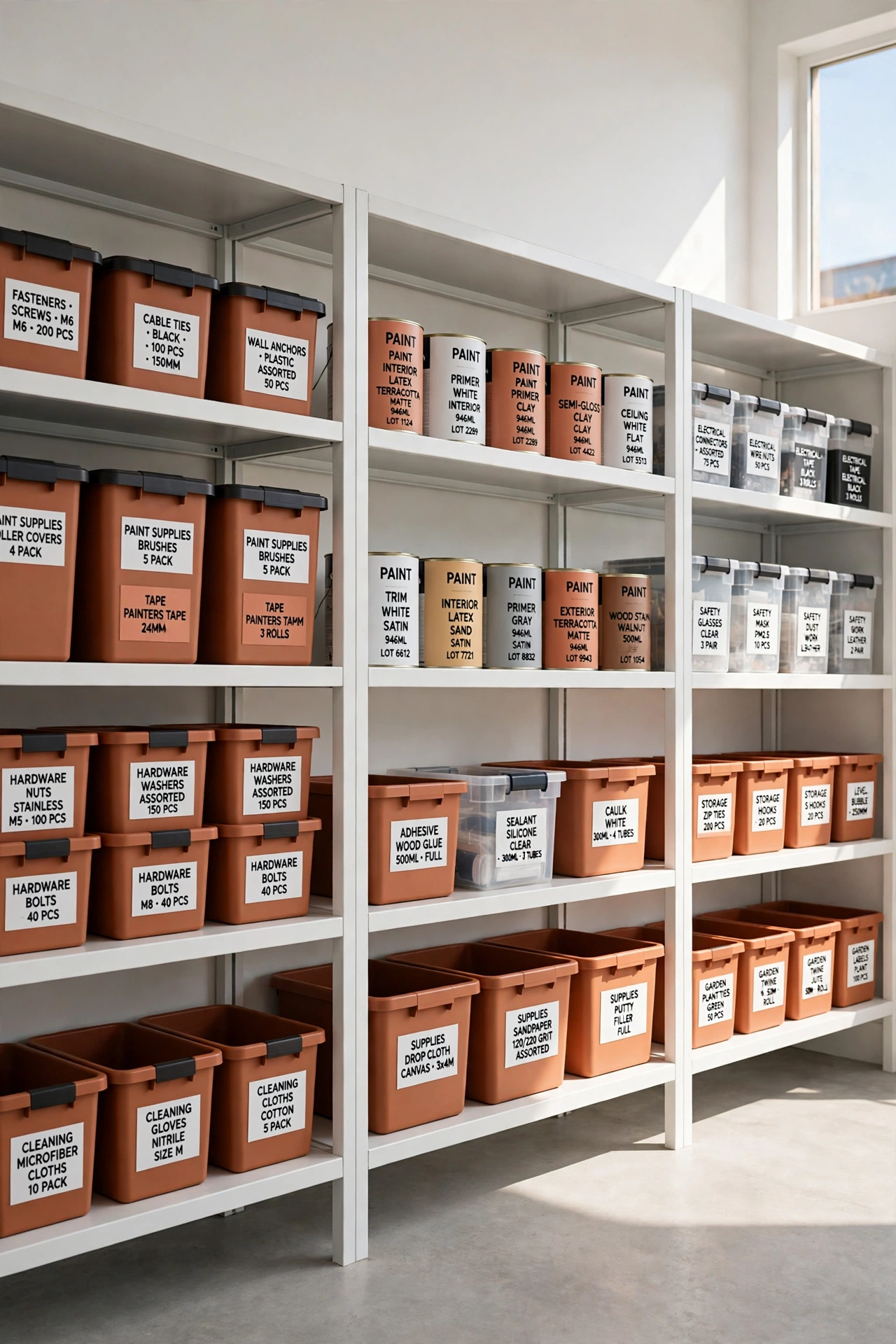
If you want an open layout without lots of little compartments, long shelf bays are the answer. Long shelves run along the wall with upright supports dividing them into wide sections. Each bay holds a group of items, like paint cans, garden tools, or holiday decorations.
For a narrow garage, adapt the depth to your walkway rather than copying standard proportions exactly. Keep the walkway clear so you can reach every bay without moving the car. Long bays give you big, flexible storage with very little fuss.
8. Shelves Above the Wagon
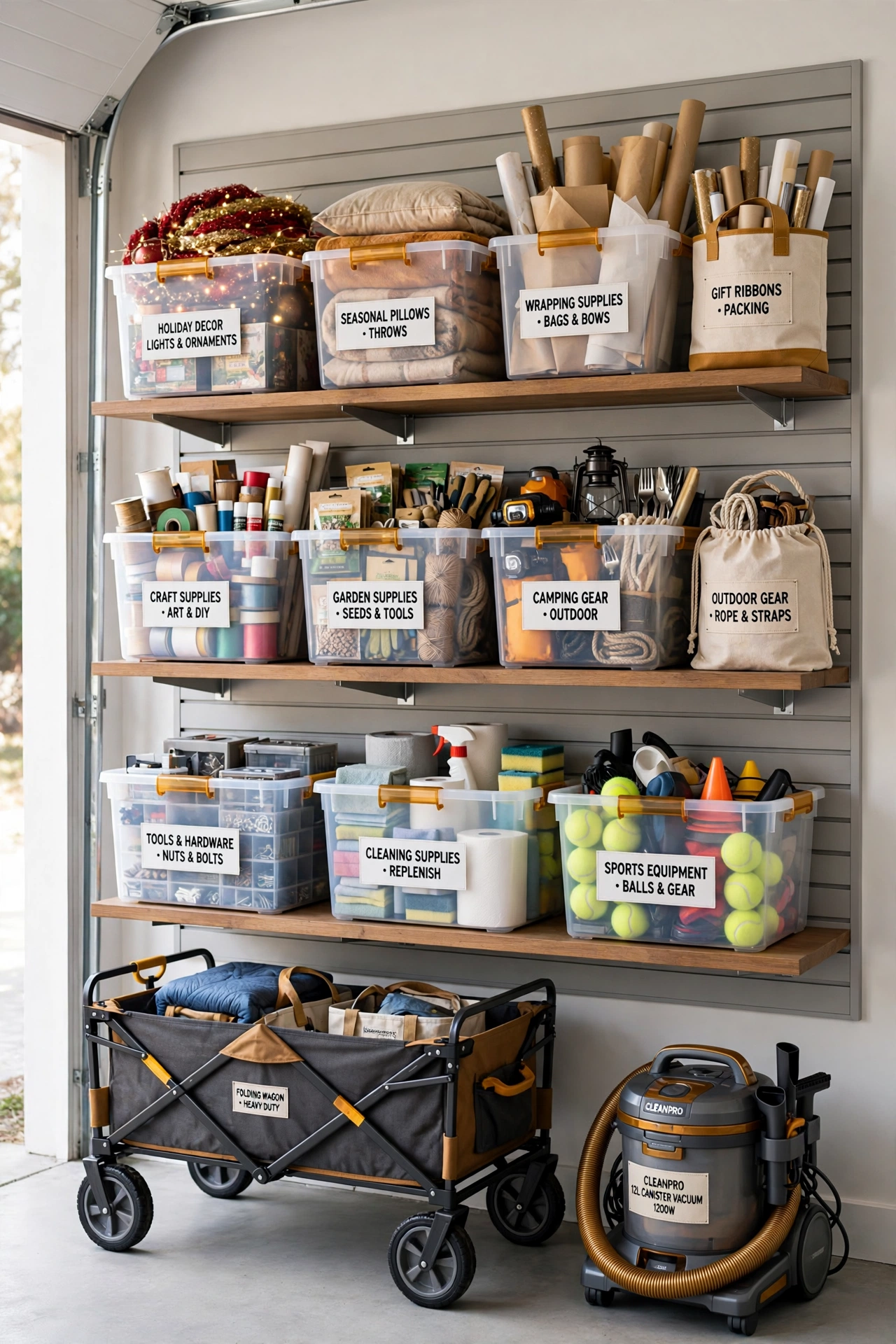
Three shelf rows above a folding wagon and a canister vacuum turn a dead wall into useful storage. Bins and bags sit on the shelves while the wagon and vacuum park underneath, so the floor space does the work twice. This arrangement keeps bulky items off the ground and out of the way.
Start your lowest shelf above the taller items you need to park below. That open space is worth planning before you settle on shelf heights. Measure the wagon and the vacuum first, then set your shelves to clear them with room to spare.
9. Pegboard with a Little Personality
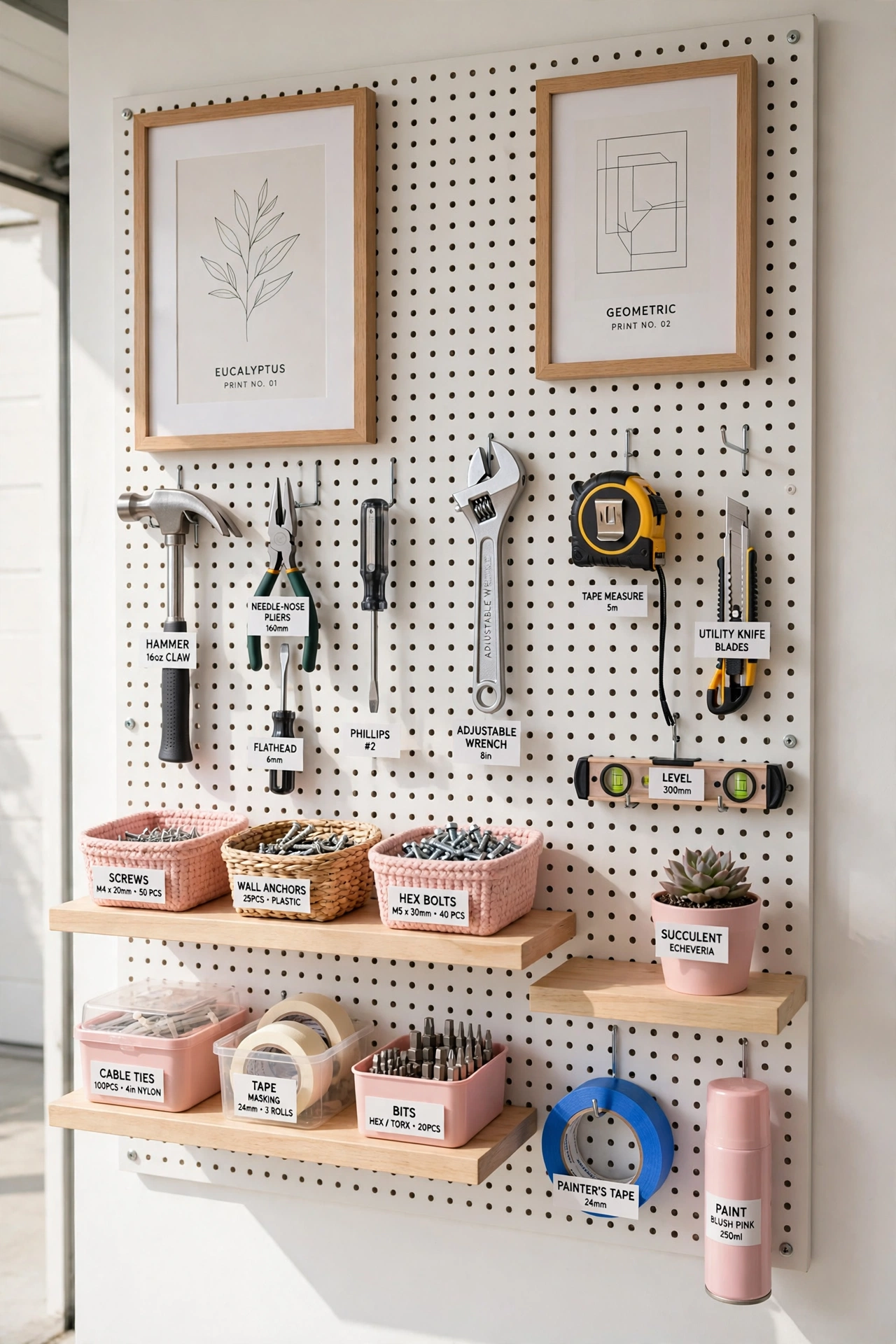
Who says a tool wall cannot have pictures too. A pegboard with framed prints mixed in with the tools, shallow shelves, and baskets turns a plain wall into a space with real character. Balls sit on one side while small bottles line the center, and every tool hangs in its own spot.
Try a few narrow shelves on pegboard if your storage is mostly little items rather than oversized tubs. Hooks, baskets, and small shelves all move around the pegboard, so the layout grows with your collection. A pegboard wall keeps tools visible and adds a personal touch to the garage.
10. A Shelf Around the Corner
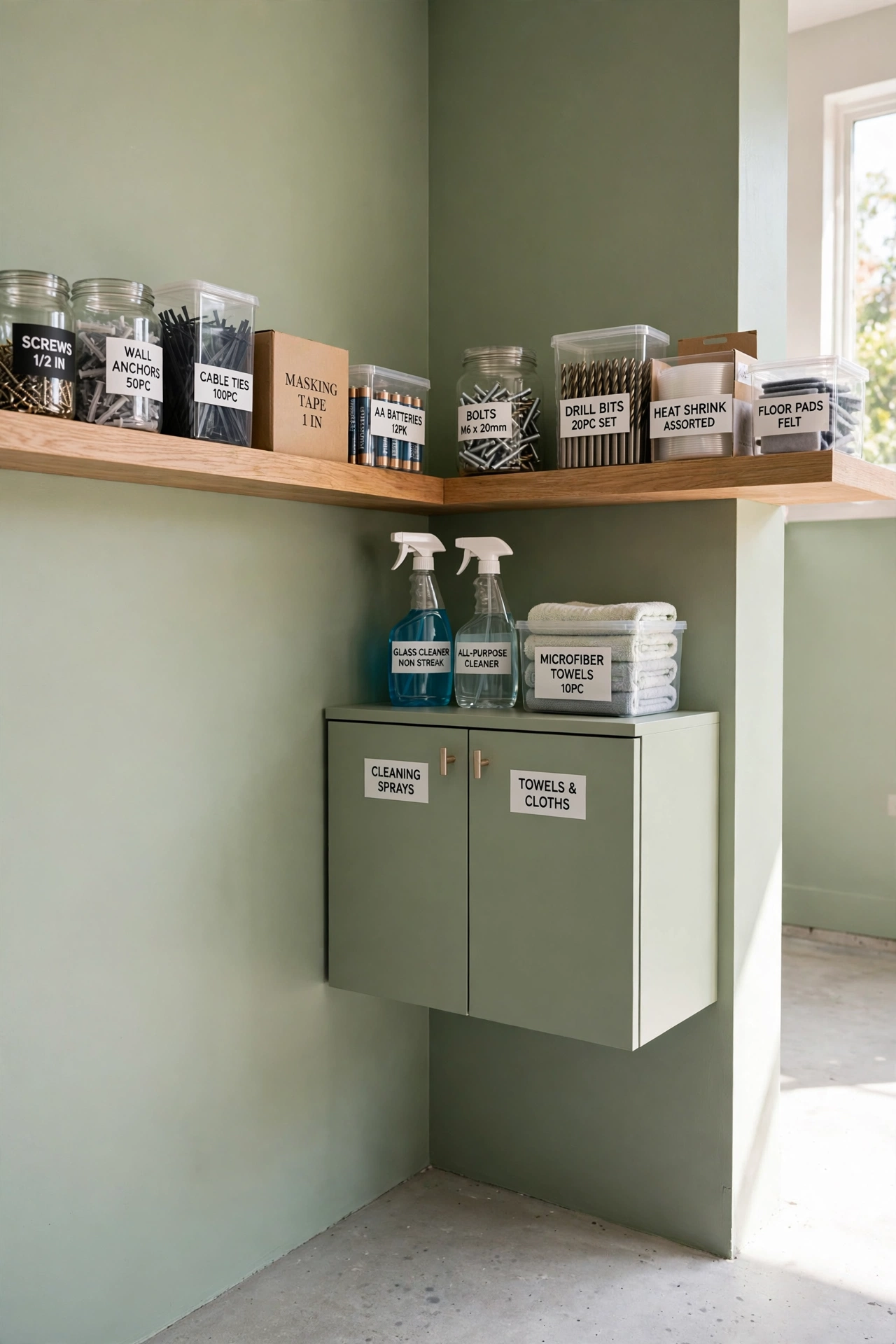
A high shelf that follows the corner uses space most garages waste completely. The shelf wraps around the corner while leaving most of the wall below open, with a small cabinet underneath and a shorter shelf on the left. It is perfect for items you reach for less often.
Use this layout for seasonal supplies, spare parts, and memory boxes. Plan how you will safely access the shelf before choosing the height, and keep a small step stool nearby. A corner shelf gives you storage without closing in the room.
11. Bike Rails in a Narrow Passage
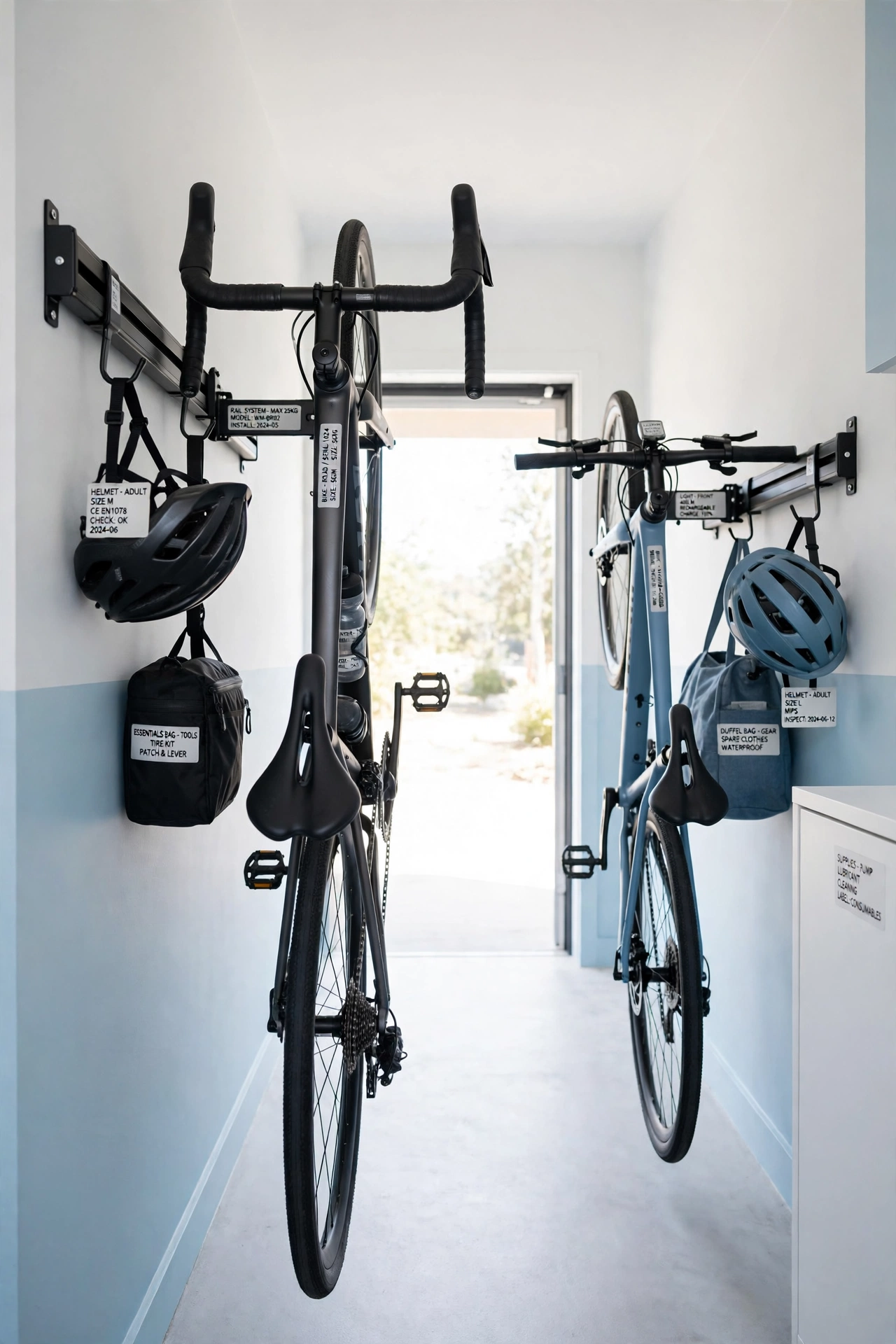
Bike rails lift bicycles off the floor and onto the wall, which frees up the narrow passage for walking. Bikes, helmets, and bags share one tall section beside the doors, and every rider knows where their gear lives. The wall-mounted arrangement keeps the floor clear for the car.
For a garage version, measure how far the handlebars project into your route. Getting something off the floor does not always mean it takes up less room, so check the clearance before you mount the rails. Bike rails work best on a wall that does not block the car doors.
12. Rolling Base for Movable Shelves
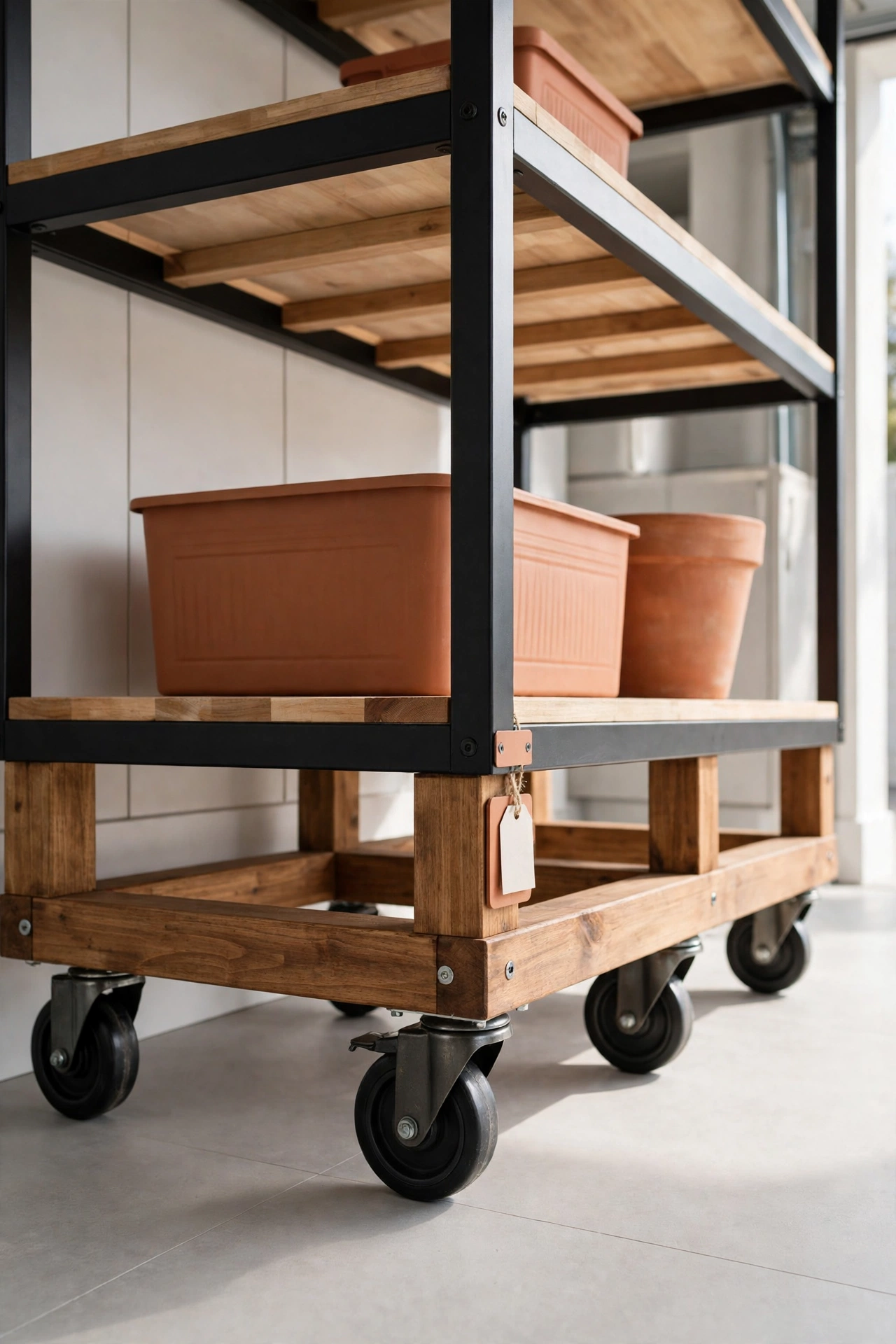
A rolling base with four sturdy casters turns a fixed shelf into a movable one. You can roll the unit out to clean behind it, pull it to the driveway for a big project, and push it back when you are done. The casters sit across two pale crosspieces that spread the weight evenly.
Choose a base with locking casters so the shelf stays put when you need it to. If you want movable storage, use the rolling base as the detail to discuss when choosing a suitable unit. Movable shelves are ideal for garages that change use through the year.
13. A Single Column of Bins
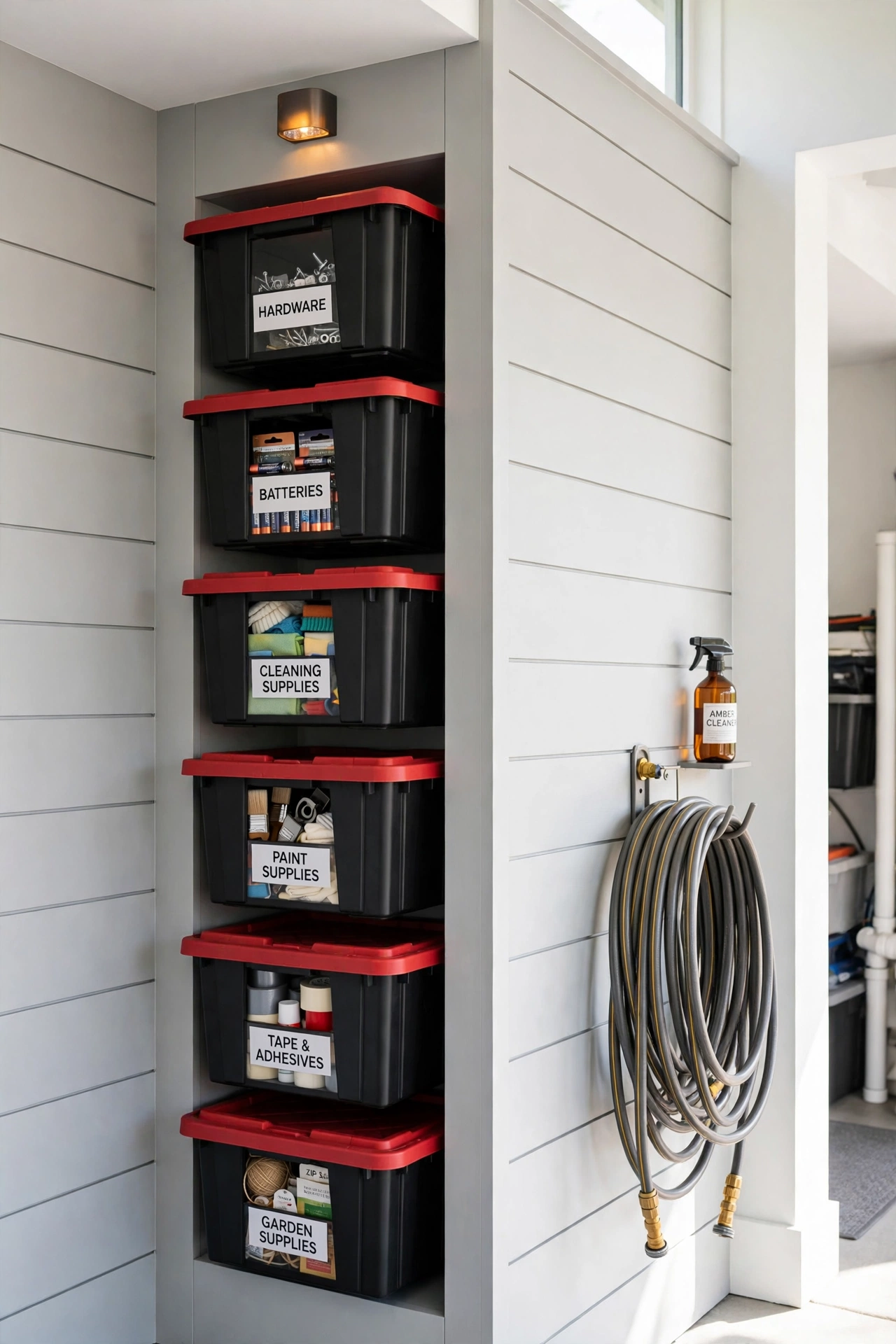
A single column of bins is a narrow storage tower that fits on a small wall section where a wide shelf never would. Black bins with red lids sit in individual openings, with casters beneath the frame and a coiled hose hanging alongside. Each bin holds one category, so nothing gets buried.
Keep the one-bin-wide layout for a small wall section and choose a tall rolling unit only if the space allows it. Check the stability guidance and use locking casters on any tall unit. A single column proves that even a narrow strip of wall can hold a lot.
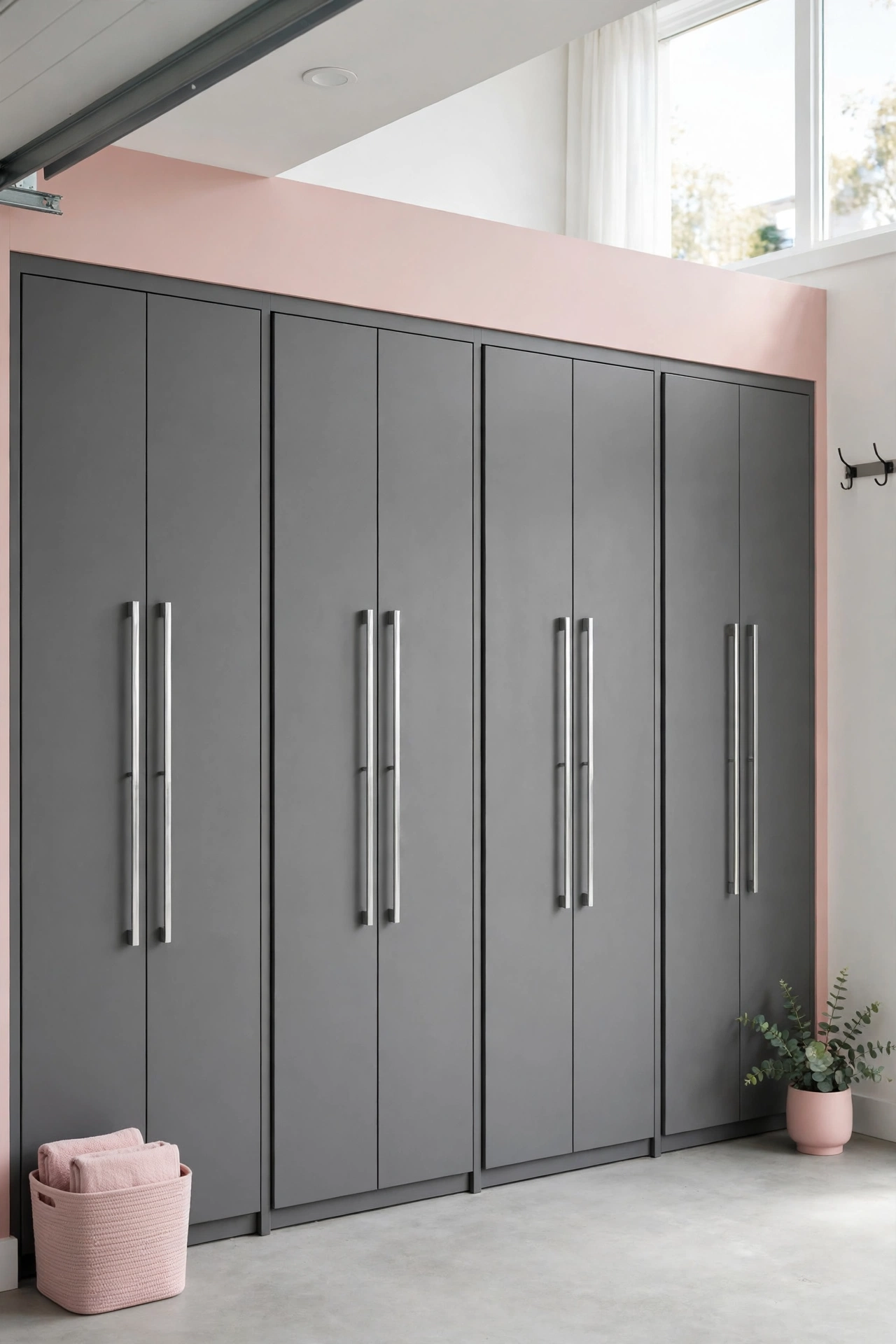
14. Closed Doors for a Clean Look
If you do not want your supplies on display, tall cabinets with closed doors give you a different direction from open shelving. The plain gray fronts and long silver handles look neat together, and everything inside stays dust free. Closed doors hide the clutter completely.
Ask about adjustable shelves inside so you can fit tall and short items in the same cabinet. Check that the doors can open beside your parked car before you buy. Closed cabinets suit garages that double as a workshop or a laundry area.
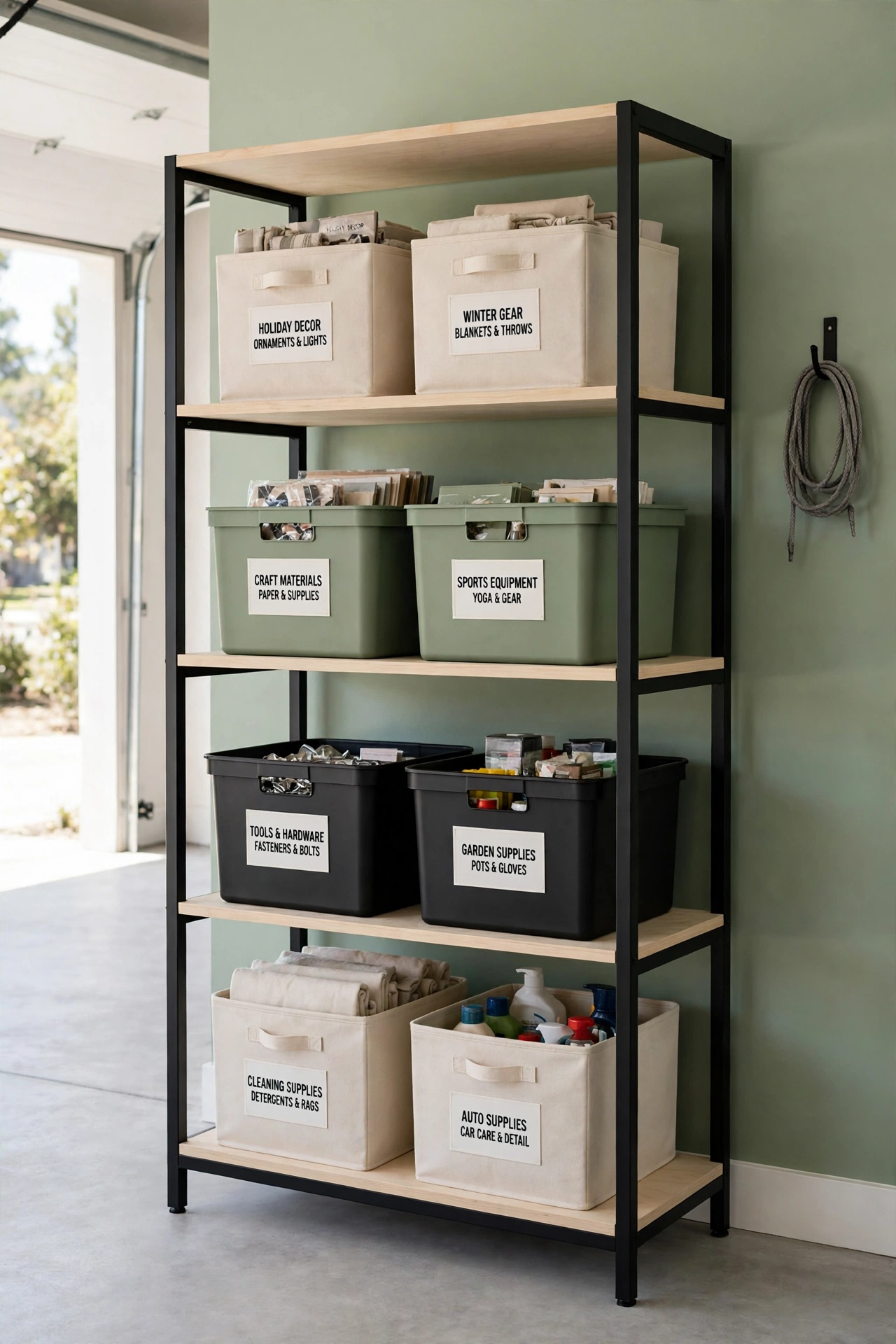
15. A Black Frame with Pale Shelves
A simple black frame with pale wooden shelves gives a garage a clean, modern look without extra drawers or doors. The tall open frame has widely spaced shelf levels, so tall bins and boxes fit without a struggle. The pale shelves make labels easy to read.
Before choosing a unit this tall, check the space beneath your garage door tracks. Keep any nearby equipment service clearance open too. This frame suits a garage that needs strong, simple storage with a tidy appearance.
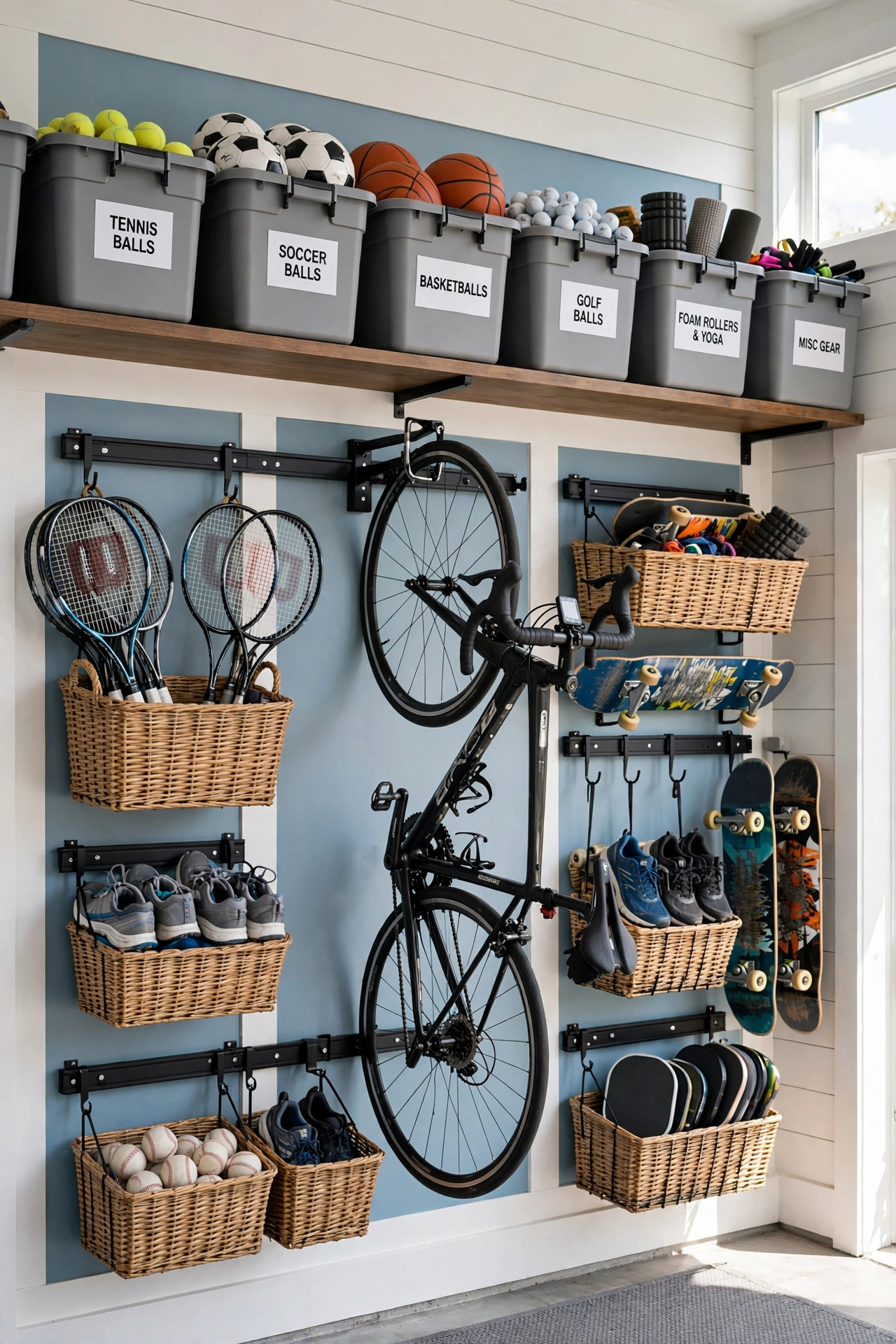
16. High Bins and Sports Baskets
Sports gear gets its own wall in this setup. Gray bins line the high shelf while baskets and hooks below hold shoes, balls, rackets, and skateboards. There is even a bike hanging in the middle, so the whole family sports collection lives in one place.
Separate the occasional-use bins from the gear you grab regularly, just like this arrangement. For more ways to keep family sports gear tidy, see these sports gear organization ideas. A dedicated sports wall stops gear from spreading across the garage floor.
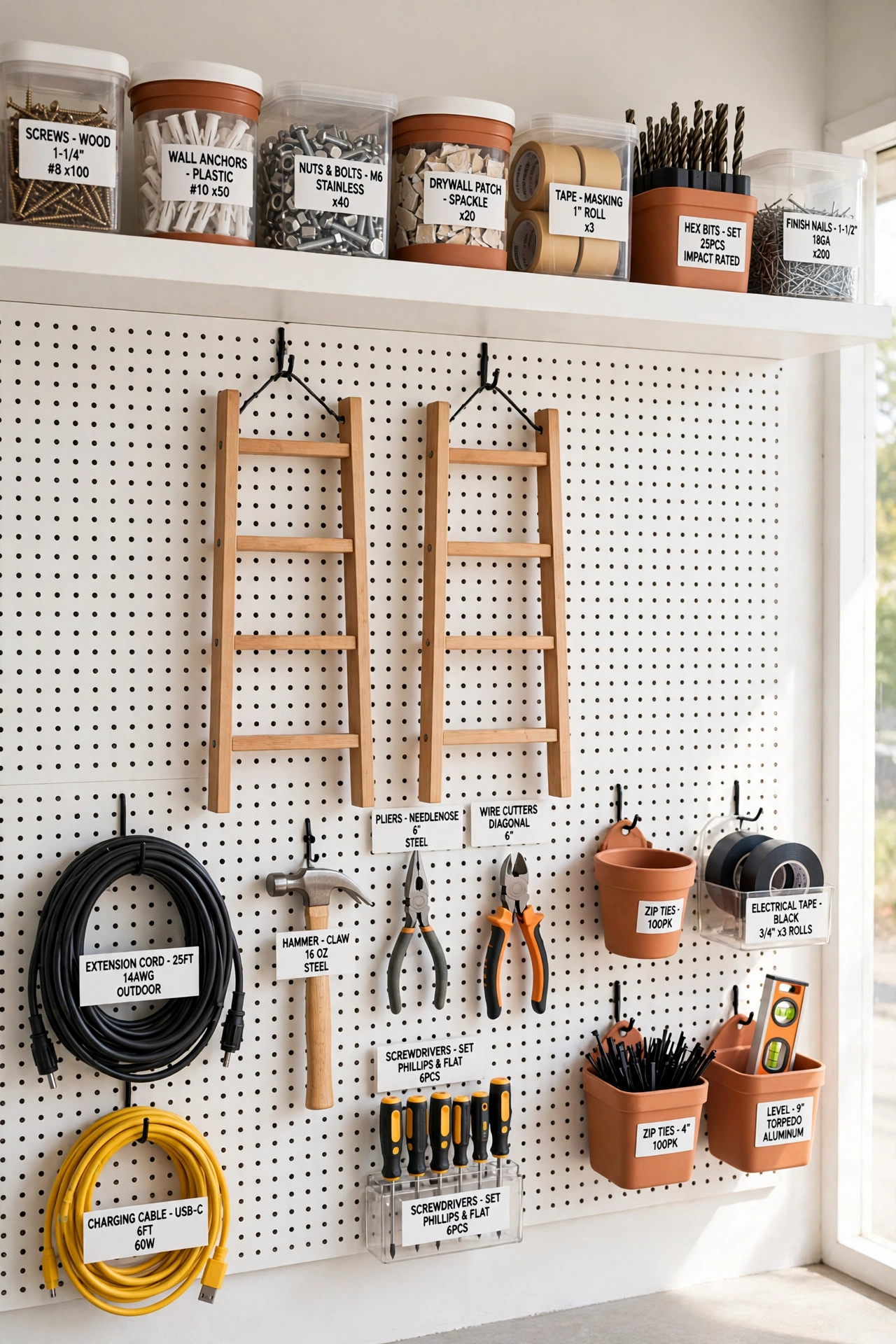
17. One Shelf Above the Tools
If you want to store long tools without adding deep lower shelves, one high shelf above the tool area is the answer. A high white shelf runs above ladders, cords, and hanging tools, and the white pegboard blends into the wall behind it. The shelf holds boxes and supplies that would otherwise pile up on the workbench.
Keep the lower area for hanging storage if that is where you need extra passing room. Long tools hang below the shelf where they are easy to grab. This single shelf adds storage without taking a single inch of floor space.
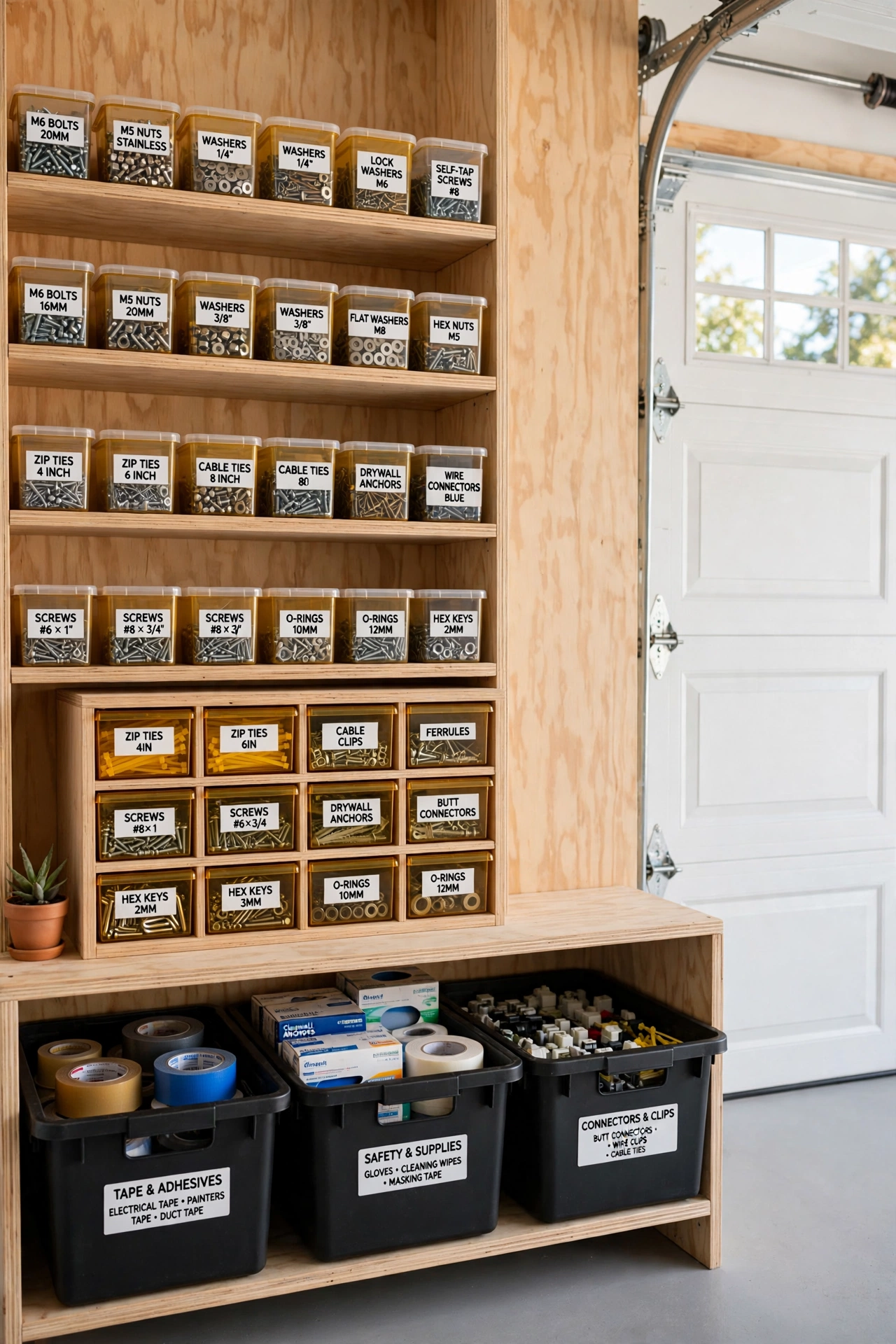
18. Shallow Shelves Beside the Door
The wall beside the garage door is one of the most useful spots in the whole garage. Shallow shelves share one tall backing panel, with small parts drawers in the middle and matching black bins below. The shallow depth keeps the walkway clear while holding a surprising amount.
Choose shallow organizers for a similar spot, and check the moving door and its hardware before deciding how far the shelves can project. For more ideas on keeping the area by the door tidy, see these entryway organization ideas. This is smart storage for a spot that usually goes unused.
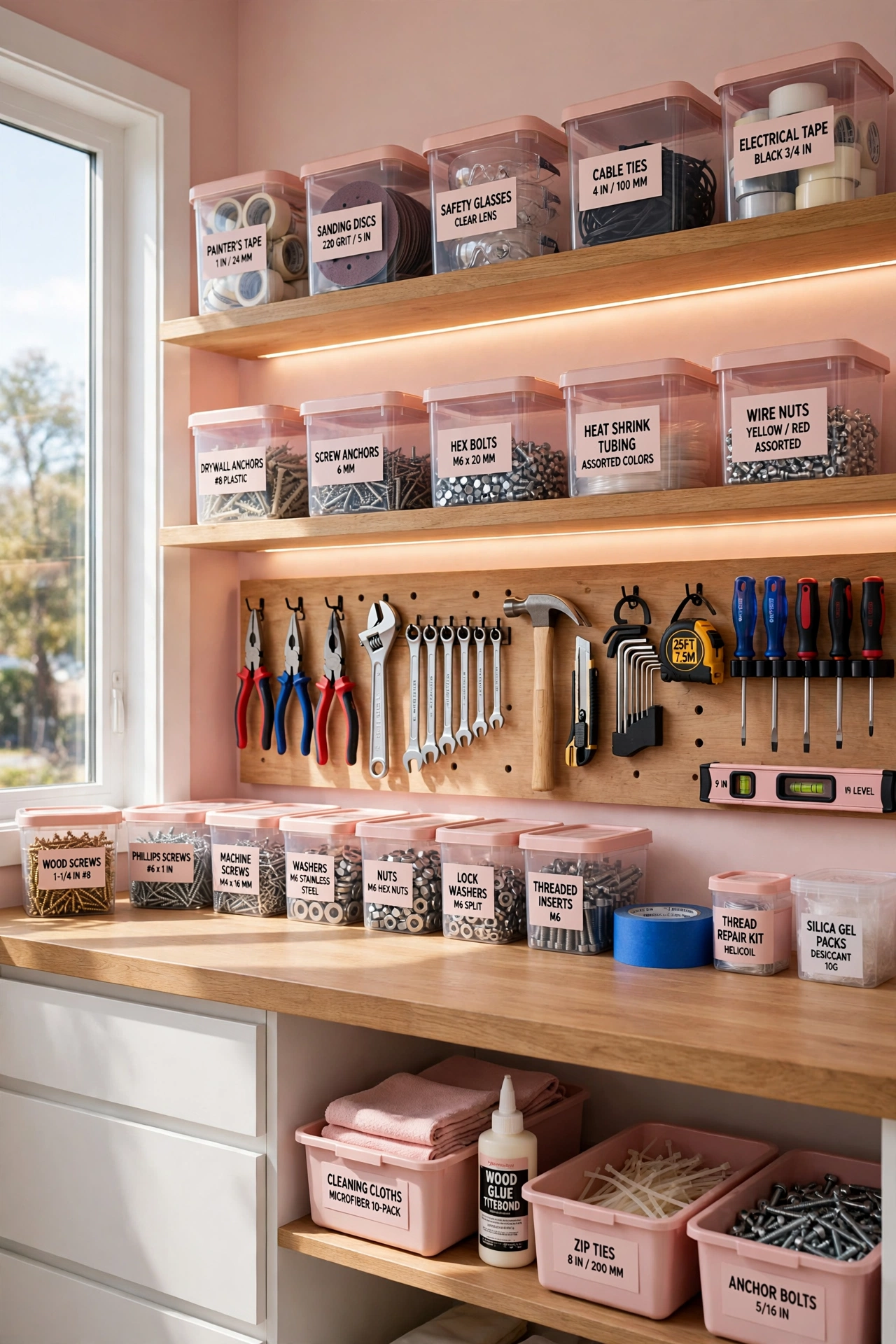
19. Lit Shelves Over a Tool Bench
If you want to go all out with a workshop wall, lit shelves over a tool bench are the centerpiece. Light strips run beneath the upper shelves, above rows of hanging tools and a long worktop. The light makes small parts easy to see and the whole bench feel like a real workshop.
The full setup is more involved than a few shelves, so for a smaller version, borrow the lit upper shelf and one section of tool storage. For more bench storage ideas, see these garage workbench organization ideas. Good lighting turns a dark garage corner into the best work spot in the house.
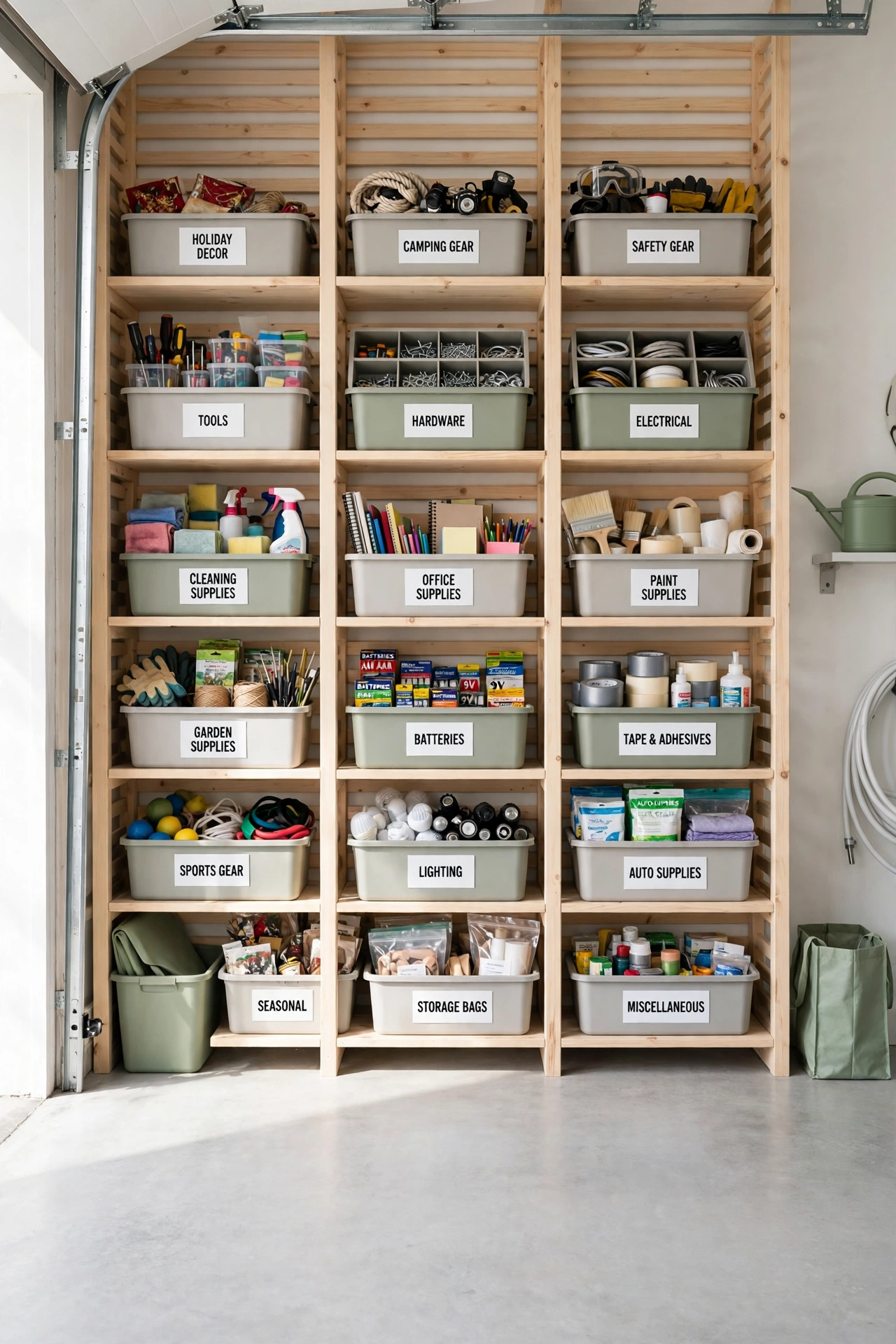
20. Open Shelves with Slatted Surfaces
Tall shelves with spaced slats give a garage an airy, open feel while holding plenty of bins. The pale frame runs along the garage wall, leaving the center floor open for the car and for walking. Air flows through the slats, which keeps stored items dry.
Use bins to keep little items from slipping between the slats. Measure the largest container first so the shelf spacing works for what you already own. Slatted shelves suit garages that need strong storage with a light, open look.
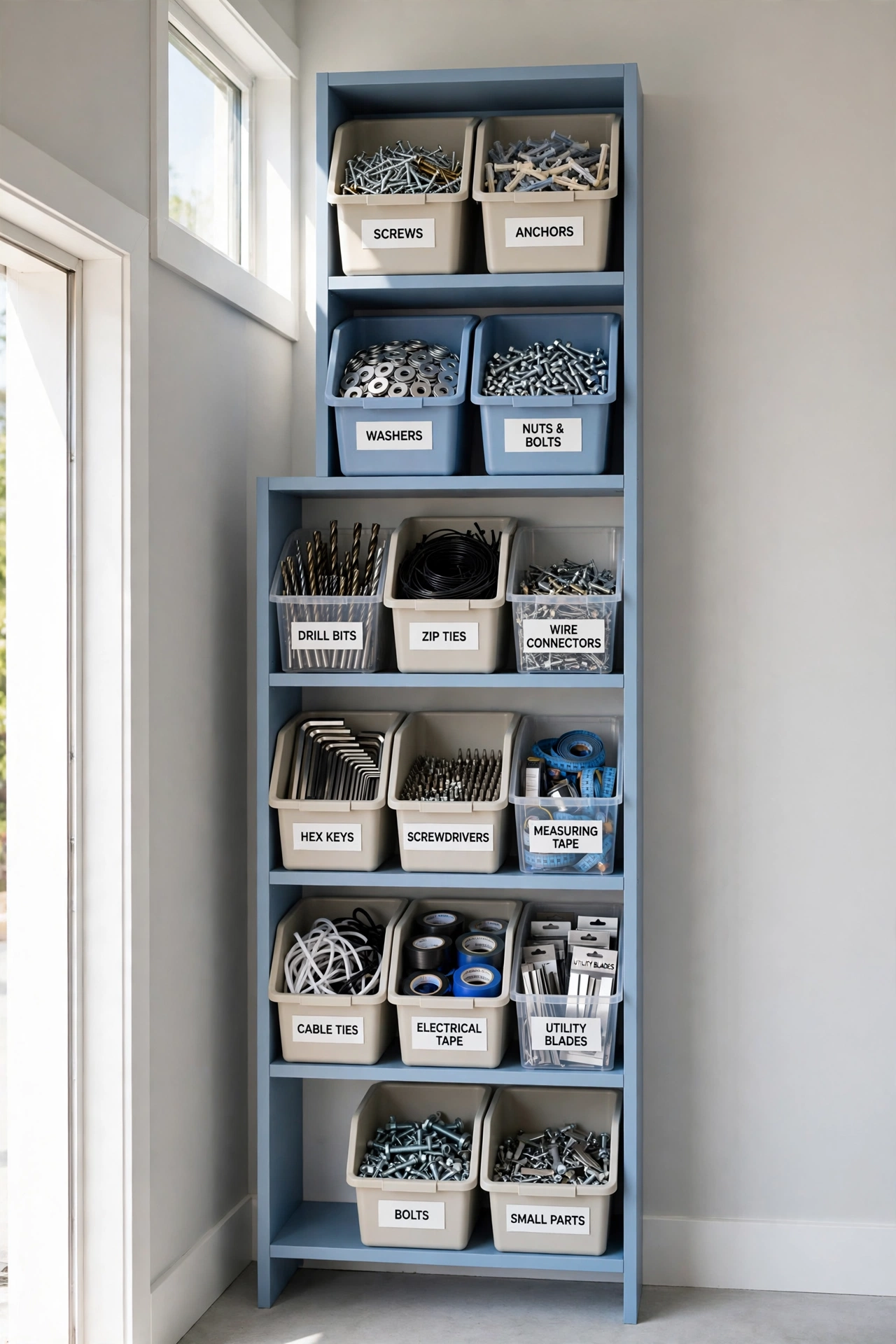
21. Slim Tower Shelves for Narrow Walls
Slim tower shelves are tall, narrow units that fit on wall sections too small for a wide shelf. Each level holds labeled bins and small tools, and the tower uses height that is usually wasted. Two slim towers on either side of a door can hold as much as one wide shelf.
Anchor each tower to the wall so it cannot tip, and keep the heaviest bins on the lowest level. Slim towers suit narrow garages where every inch of wall matters. They also work well beside a workbench for tools you reach for often.
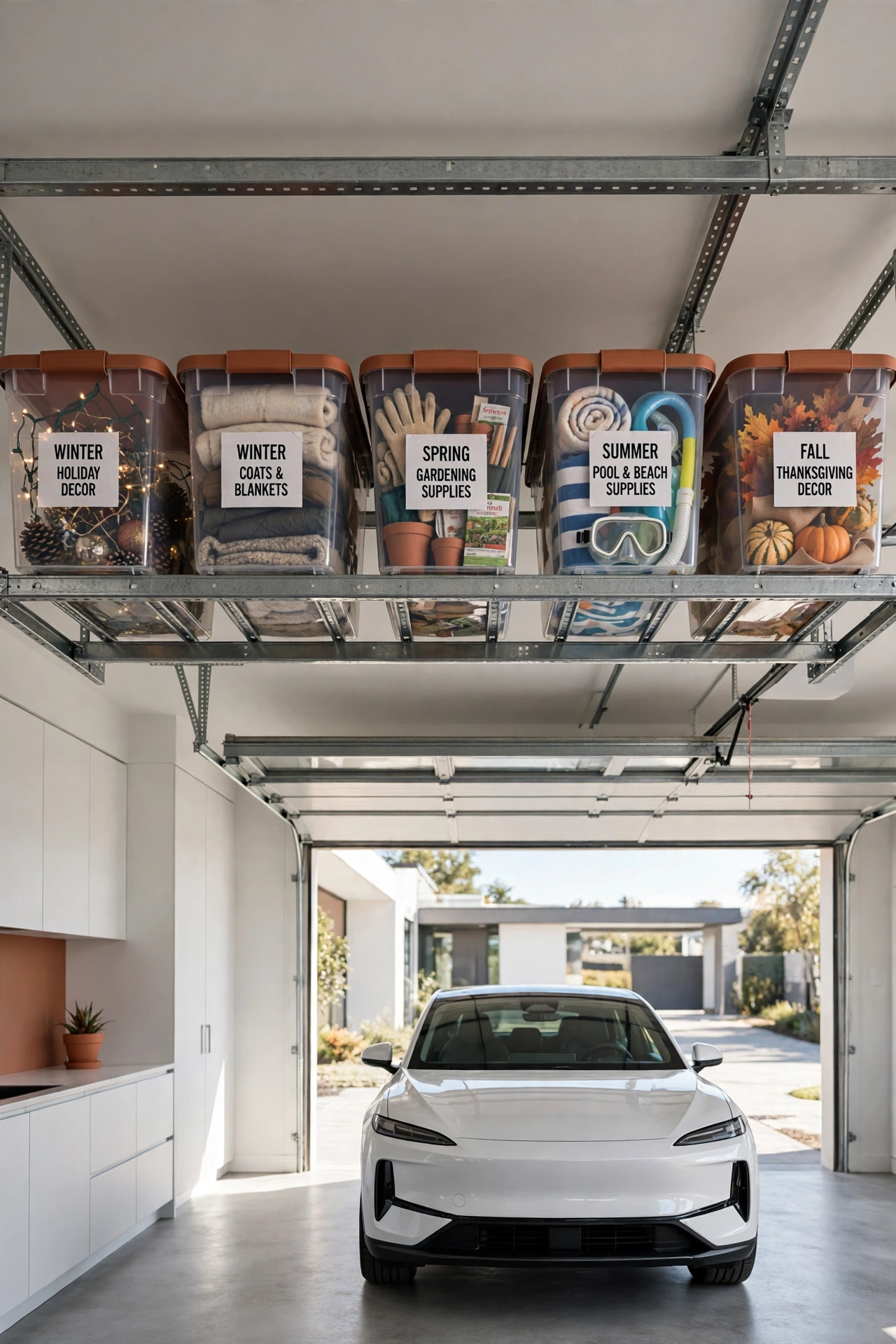
22. Overhead Ceiling Racks for Seasonal Bins
Overhead ceiling racks are the best home for seasonal bins you only touch twice a year. Holiday decorations, camping gear, and winter supplies ride high above the car on a sturdy steel rack, out of the way but easy to lower when the season changes. The floor stays completely free.
Check the rack load rating and anchor it into ceiling joists, never into drywall alone. Label each bin on two sides so you can read it from the ground. Seasonal racks free up wall shelves for the items you use every week.
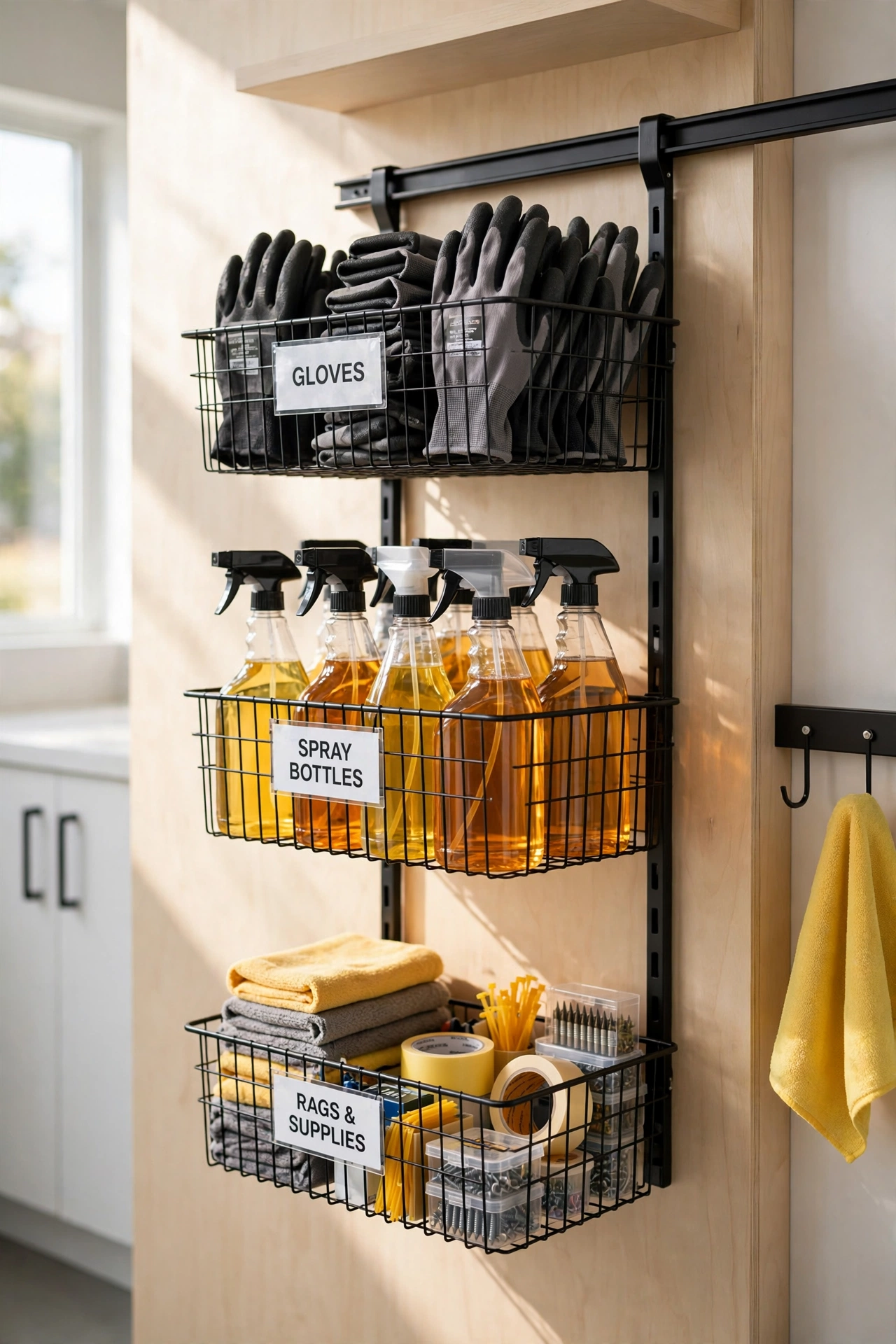
23. Wall-Mounted Wire Baskets for Small Items
Wall-mounted wire baskets are perfect for the small items that clutter every garage shelf. Gloves, spray bottles, rags, and spare parts each get a basket, and the open wire lets you see what is inside. The baskets mount on a rail, so you can slide them along or lift them off.
Mount the rail at a height that is easy to reach, and keep the baskets you use most often at arm level. Wire baskets suit the wall beside a workbench or near the garage door. They turn a pile of small items into a tidy row you can scan in seconds.
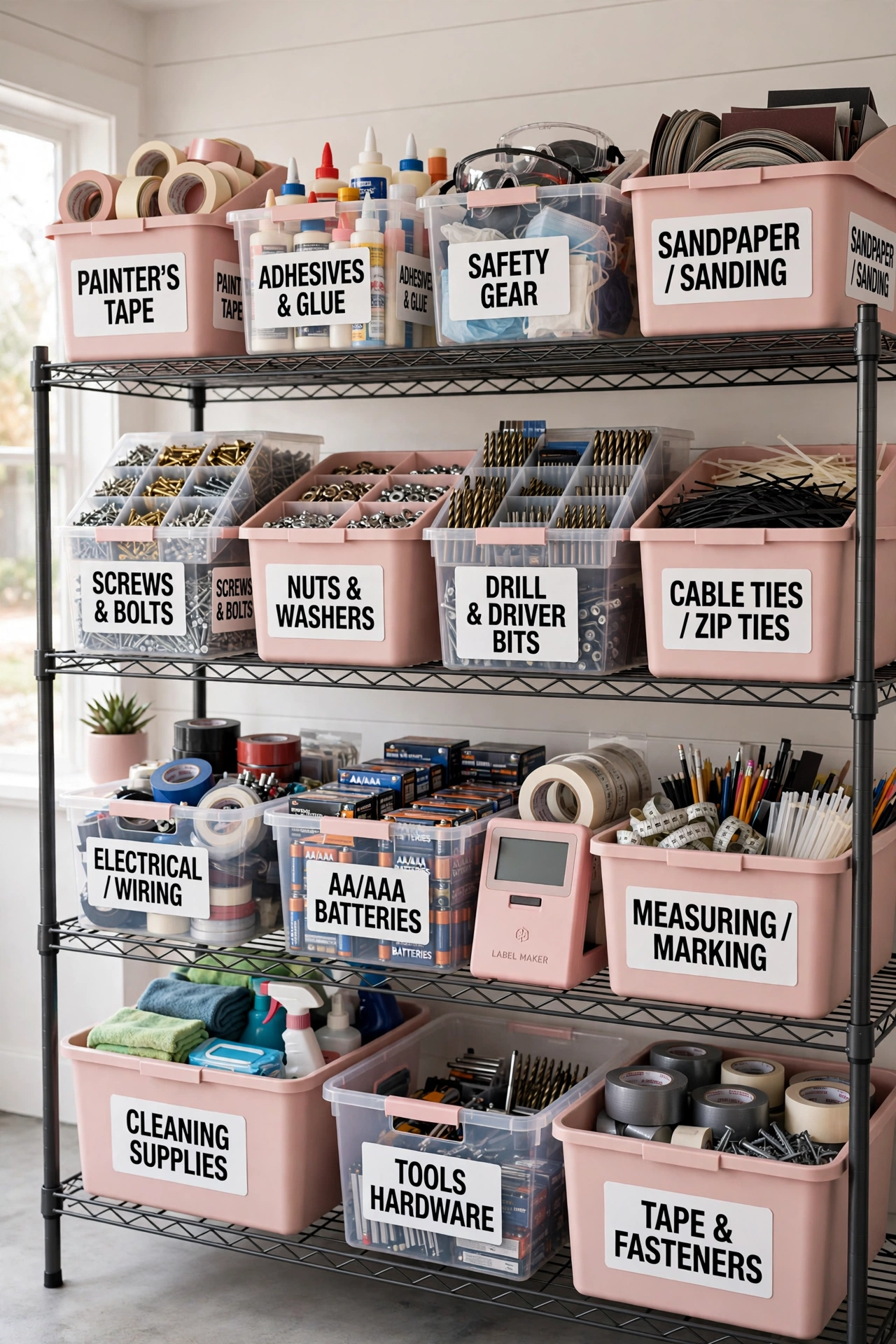
24. Label Every Shelf Clearly
Labels are the habit that keeps every other garage shelf idea working. A clear printed label on every bin and shelf tells the whole family where things belong, so items go back to the right spot after use. Without labels, even the best shelves slide back into a mess within weeks.
Use large, bold labels that you can read from the garage door, and put the same label on the front and the side of each bin. A label maker gives a clean result, and simple handwritten labels work just as well. Labeling takes an afternoon and saves hours of searching all year.
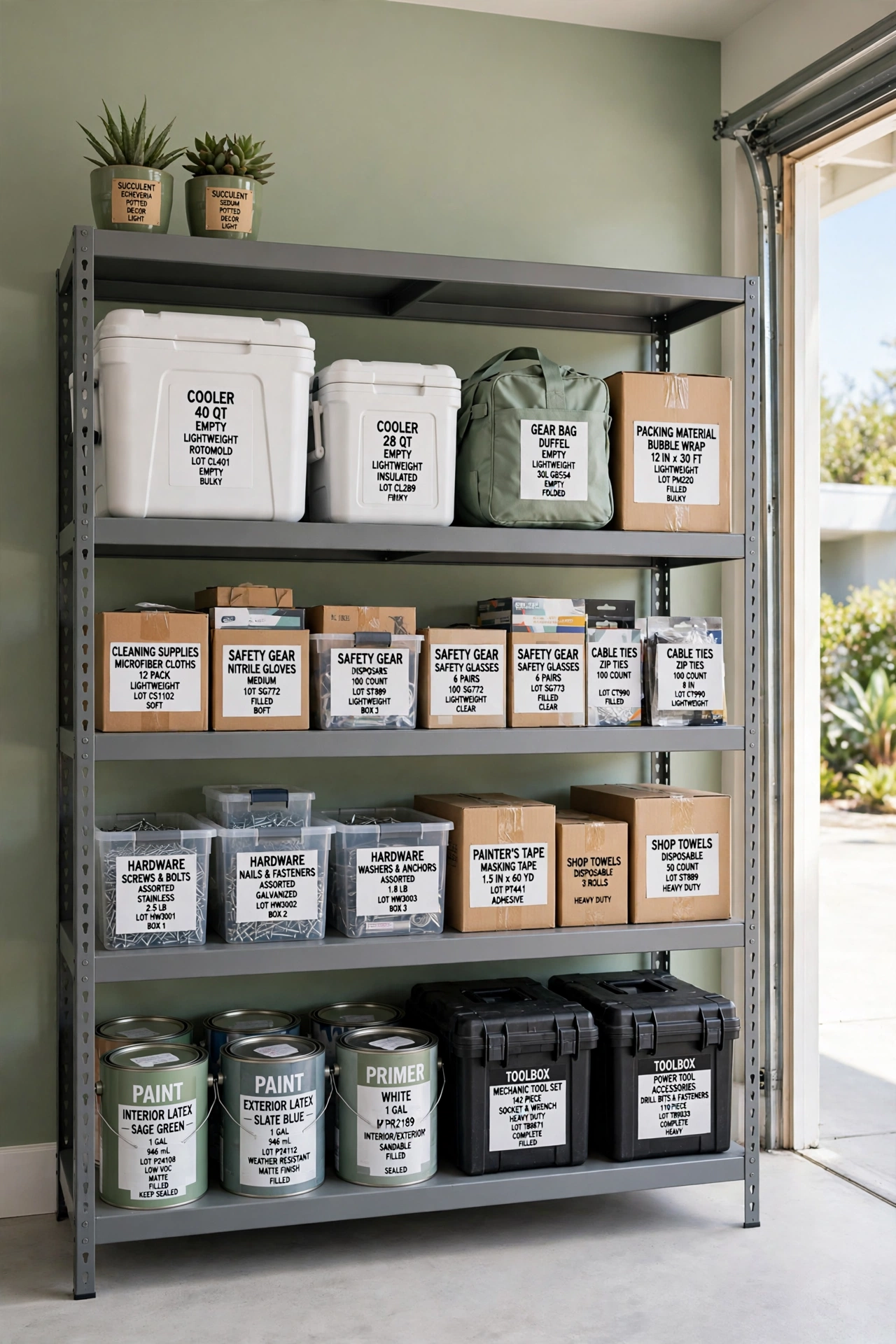
25. Keep Heavy Items Low and Light Items High
Heavy items belong low and light items belong high, and this simple rule keeps garage shelves safe. Paint cans, toolboxes, and bags of salt sit on the lowest shelves where they are easy to lift and cannot fall far. Bulky but light items, like empty coolers and camping chairs, go up top.
Never store heavy items above shoulder height, and keep the center of gravity low on any tall unit. This habit protects your back and your shelves at the same time. A shelf loaded by weight, not by chance, stays strong for years.
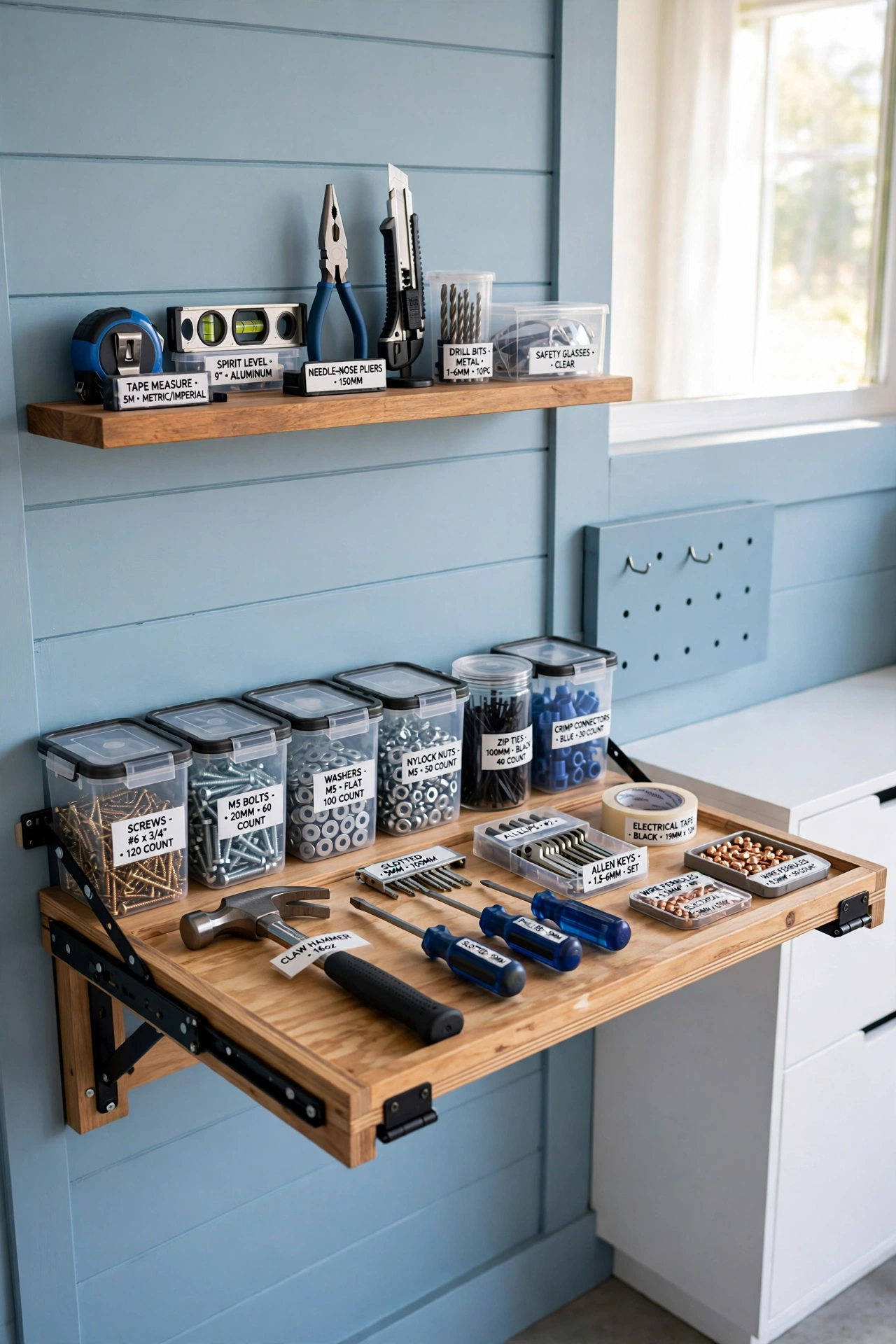
26. A Fold-Down Workbench Shelf
A fold-down workbench shelf gives you a work surface only when you need it. The shelf folds up flat against the wall when the project is done, so the garage keeps its full parking space. When it is down, it holds tools, parts, and a small vise with room to work.
Mount the shelf on sturdy brackets rated for the weight you plan to use, and add a folding leg for extra support. Keep the tools for the bench on a small shelf right above it. A fold-down bench suits small garages that need a workshop without losing a parking spot.
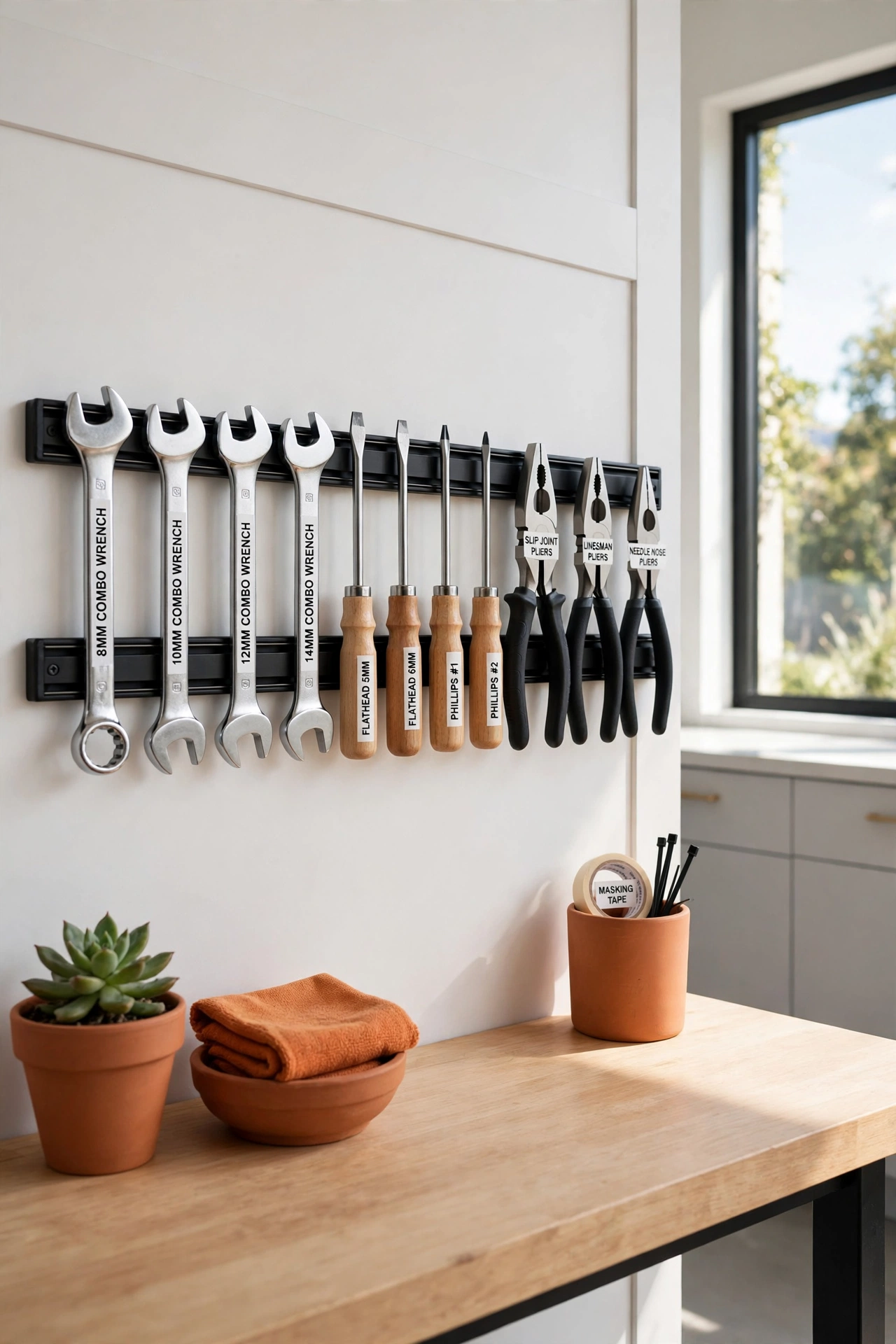
27. Magnetic Strips for Metal Tools
Magnetic strips hold metal tools in a neat row on the garage wall, where you can see and grab each one. Wrenches, screwdrivers, and pliers stick to the strip and stay put, which frees up drawer space for other supplies. The strip takes almost no room at all.
Mount the strips above the workbench at a height that is easy to reach, and keep sharp edges facing the wall for safety. Group tools by type so the row reads like a chart. Magnetic strips are a cheap upgrade that makes a workbench feel professional.
28. Stackable Bins with Lids
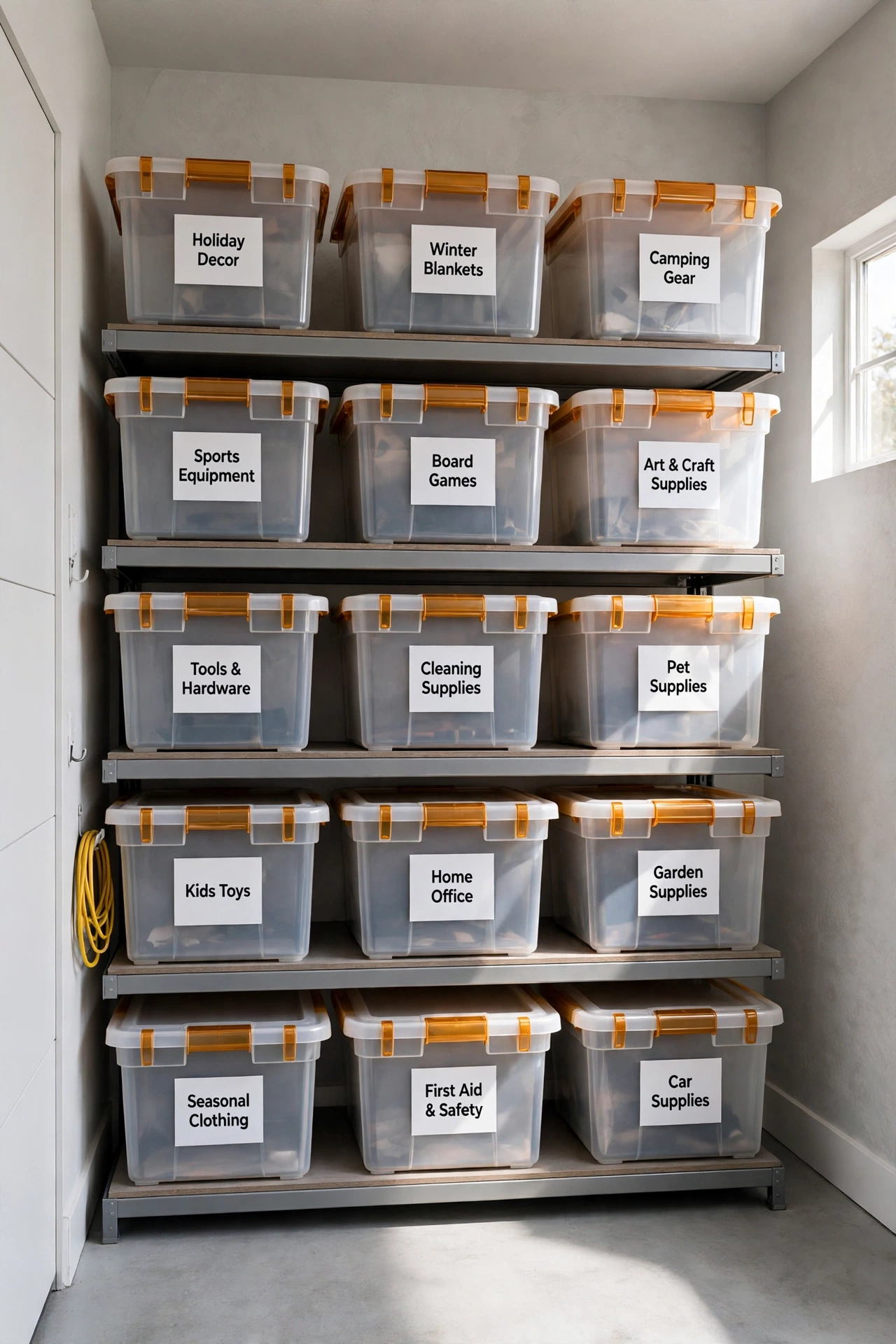
Stackable bins with lids are the workhorse of garage shelf storage. The lids keep out dust and moisture, and the bins stack neatly on shelves or on the floor without sliding. Clear bins let you see the contents, while solid bins hide the clutter completely.
Choose bins in one size so they stack evenly, and label each lid as well as the front. Keep one empty bin on hand for the next round of decluttering. Stackable bins turn a messy shelf into a tidy wall of storage in a single afternoon.
29. A Seasonal Rotation Routine for Garage Shelves
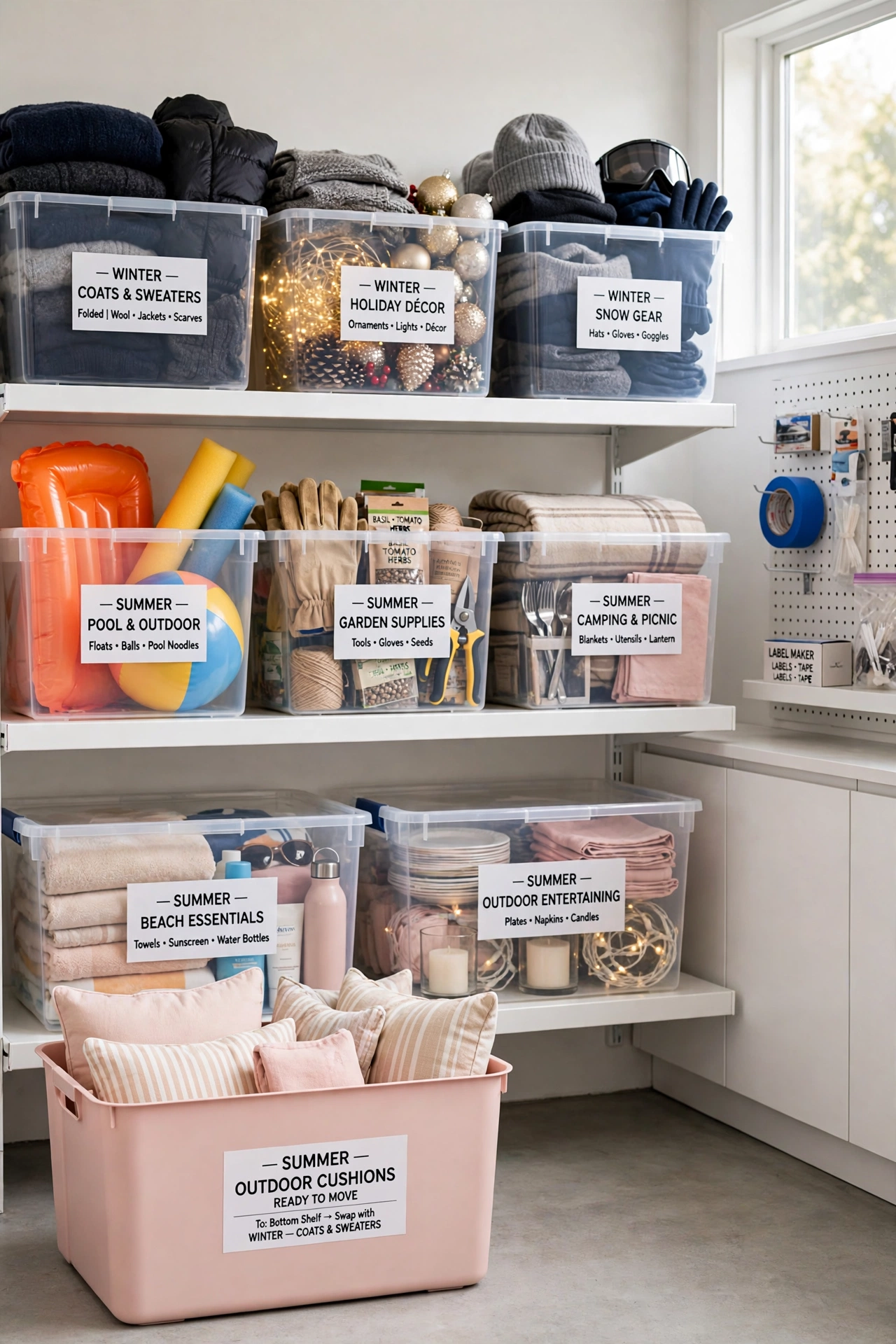
A seasonal rotation routine keeps garage shelves useful all year instead of frozen in one season. Twice a year, swap the bins on the easy-to-reach shelves: winter gear moves up high in spring, and summer gear moves up high in autumn. The items you need now always sit at arm level.
Set a date for the swap, like the first weekend of spring and autumn, and make it a family job that takes under an hour. Check labels as you rotate, and toss anything broken or unused. A simple routine means your garage shelves never go back to being a dumping ground.
Conclusion
Garage shelf organization does not have to be complicated or expensive. From open wire shelves to ceiling racks and labeled bins, there is an idea here for every garage and every budget. The best system is the one that keeps your car parked inside and your supplies easy to find.
Pick one or two ideas that fit your walls and start today. Measure your space, add labels, and give every item a home. For a calm home beyond the garage, these nightly reset routine ideas will help you keep every room tidy with just a few minutes each evening.
Frequently Asked Questions About Garage Shelf Organization Ideas for Household Supplies
How deep should garage shelves be?
Most garage shelves work best at 12 to 18 inches deep. Shallow shelves suit small items and narrow walls, while deeper shelves hold large bins. Measure your walkway first so the shelves never block the car doors.
How high should garage shelves be above the car?
Leave at least 12 inches of clearance above the tallest point of your car, including roof racks. Overhead racks need even more room for the garage door to travel. Measure the car and the door path before you install anything overhead.
What is the best way to label garage bins?
Use large, bold labels on the front and the side of each bin so you can read them from any angle. A label maker gives a clean result, and simple handwritten labels work just as well. Group bins by category and keep the label wording short.
How do I keep heavy items safe on garage shelves?
Store heavy items on the lowest shelves and never above shoulder height. Check the shelf load rating before you load it, and anchor tall units to the wall. Spread heavy items across several shelves instead of piling them on one.
Can I organize a narrow garage without losing parking space?
Yes, wall shelves, ceiling racks, and slim towers use vertical space instead of floor space. Shallow shelves beside the door and high shelves above the car add storage without moving the car. Measure the walkway and car door swing first, then plan shelves around them.

Hi, I’m Emily! I turn messy corners into cozy, organized spots. DreamNestDecor is where I share simple, practical home ideas — decor, organization, and small-space solutions that work in real life, not just in photos. Every idea here is carefully researched before it’s shared.